Showing posts with label volunteer. Show all posts

Monday, 5 March 2018

Should you volunteer in Africa? (the answer may surprise you)


Rice trials with the regional minister of Ag
I spent last year in rural Ghana working on women's economic development projects with a Canadian NGO. In the beginning I was a little naive in thinking that I had found an organisation apart from the rest, above the issues typical in development orgs and that it would allow me to fulfil a lifelong dream of building a career in Africa. But what I learned was that there are some serious issues with traditional development, something I thought I knew but failed to acknowledge. There are also amazing people doing really meaningful and effective work. It is up to us to dig through the noise and find the gems doing the good, honest work that will affect change.

The question remains, should you volunteer in Africa or the developing world in similar roles/ agencies. No, I would not recommend it. But do I have any regrets and would I do it all over again if I could? Probably, because I didn't know any better until I had experienced it for myself. It comes down to, do you want to support a system of ineffective projects based on colonial models of development?

These big agencies peddling volunteer positions do have a great sales pitch to pray on those of us wanting to share out skills and time for good. They also lead us into thinking we are somehow capable of achieving feats the previous volunteers were unable to. They get their funding from governments and large corporate grant programs that enable them to continue the cycle of raising funds to perpetuate their ability to raise more funds. Unfortunately, a very limited amount of this money actually reaches the beneficiaries of the projects and the bulk of work is lost in over inflated reports amplifying little success and sweeping major issues under the rug.  There are smaller grassroots groups that I interacted with that created projects by locals that supported locals, if I could do it all over again I would align myself with them.

Women's group showing their first harvest
My role was as a women's empowerment adviser but I found that the organisations we were partnered with were furthering the problems of gender inequality with widely tolerated and accepted patriarchal structures and little in the way of training or understanding to counter this. They heavily relied on funding from our positions to pay salaries and apart from this it didn't seem like they were interested in the projects success. This was a big issue for me. Since leaving Ghana the women I worked with have had little to no contact with the organisations, and no more support. We were doing development for developments sake and not apart of a sustainable structure to promote actual change.

So if you too are interested in going abroad and spending your time volunteering, please do it. Thank you for your dedication to others and for sharing your time with the world. Here are some helpful tips to get you heading in the direction of a truly meaningful experience for you and those you endeavour to support.
  • Shop around, find out if other organisations are doing similar work in the area, is that good or bad? 
  • Learn about sustainable development research and projects happening around the world. Does your organising follow those practises? Do you share similar values? 
  • Ask hard questions, like how many volunteers have left early, issues with the locals or organisation? Have past projects been effective, is there any proof of this? DO THEY NEED YOU?
  • If you need to pay to volunteer it is potentially a voluntourism scheme in disguise, however grassroots groups with limited funding expect you to pay your way. Be critical in your research, where does the money go, where do they obtain funding? 
  • Peace and Love Women's Group
  • Can a local do this job better than you? In the village next to me there were four 18 year old German's teaching English at a school. They receive a modest 100 Euro allowance a month and have no experience and basic English themselves.  Couldn't sponsoring a qualified local teacher be more appropriate? Are you needed? 
  • The difference between a volunteer and an employee are often blurred. As a volunteer I was paid a monthly stipend of up to 10 times my local colleagues. Yet, I was still considered a volunteer and by Canadian standards I made less than minimum wage. This difference however has the effect of de-legitimising work that a paid professional might have and furthering the pay inequity of locals and expats. 
  • Is your organisation present. Are they accessible to you, are their other staff/ volunteers on the ground? My NGO had other volunteers in Accra and a support staff but unfortunately I was the only one in a remote location. 
  • Talk to previous volunteers. I read blog posts from previous volunteers but didn't reach out until after I was in the country. Some of the issues they described helped me legitimise my own personal struggles with local conditions and staff and was not something you could easily pick out from social media pictures of smiling folks. 
  • Does your organisation share information, is it transparent? I had little to no idea about other projects they were involved with nor about previous projects in my area. I felt like they were hiding the amount of failures in order to maintain positive image and recruit new funders and volunteers. Ask, ask ask! 
  • Research your org! Use sites like Charity Navigator to find out how much money is going into projects and how much is paying for over inflated salaries. Be proud of the organisation you give your time to.  
Saying goodbye
Bottom line is this: I have come across some amazing volunteer opportunities at home and abroad. There is real potential to help drive impact and with the right skills and the right organisation you can probably help in some measured capacity. So be realistic with what you can achieve in a 2 week, summer or 1 year contract in the developing world and do the research to find the right organisation for you. Volunteering really does change your life for the better, get out there and be the change you want to see in the world.

If you are looking for volunteer projects in Ghana here are some cool ones to get you started:
  • Dunk-Providing after school and athletic programming to kids and youths 
  • Global Mama's - Fair trade, women powered goods that take volunteers and interns
  • Hipsters of Nature- "Greening Ghana in style"
  • Humanist Association of Ghana- Secular support to protect human rights and promote critical thinking. 
  • Farm Radio- Supporting broadcasters in developing countries to strengthen small-scale farming and rural communities. 

More about my recent volunteer project in Greece with refugees soon!

Love,


Melanie XX

"Volunteers are paid in six figures...S.M.I.L.E.S" - Gayla LeMaire 

Tuesday, 28 February 2017

Coming to Terms With Child Labour in Ghana

I am awoken around 04:30 each morning by the sounds of the maid setting the charcoal fire outside my window. She does this so our family has hot water for making breakfast, to do the laundry and for baths, it an essential part of each day. When I arrived in the village I was introduced to the ‘girl’ who assisted with domestic work while both parents were busy running a shop in town. I thought she appeared quite young, thinking she was maybe 16, the age most kids finish school at in Ghana. I later found out she was just 12 years old.
Road Side Hawkers 

As per a recent local news story I read, up to 1.2 million children under the age of 16 are reported to be working every day in Ghana. Many of them harvesting and processing in agriculture, mainly the Cocoa that we turn into our beloved chocolates.  Critics will tell you this number is exaggerated and that kids often help their parents when they return home from school and on weekends. It only takes a periphery glance to see that this is not always the case and that little bodies occupy much of the lower income work from street hawkers, to agricultural workers to domestic service.

Grandma and maid making Fufu
Our house 'girl' works every day helping with house chores and childcare. She sweeps the dust that surely settles on the floors each morning, wipes counter tops, chases after the children, does laundry and dishes and any other tasks as required by her household. Even the children who are 18 months, 3 and 6 call for her to fetch things for them and clean up after them. When the kids are readied for school each morning she too sets off to attend classes, she is in grade 5. She returns home around 13:30 and continues with her chores until the children return home from school. She works into the evening cleaning up dishes after the mother has cooked and other tasks as assigned to her. She is given a single bed in the corner of the kid’s playroom as her space. I have never seen her eat, as she is not invited to with the family. The way she is treated by her elders is very harsh to my delicate north American understanding of child care.  

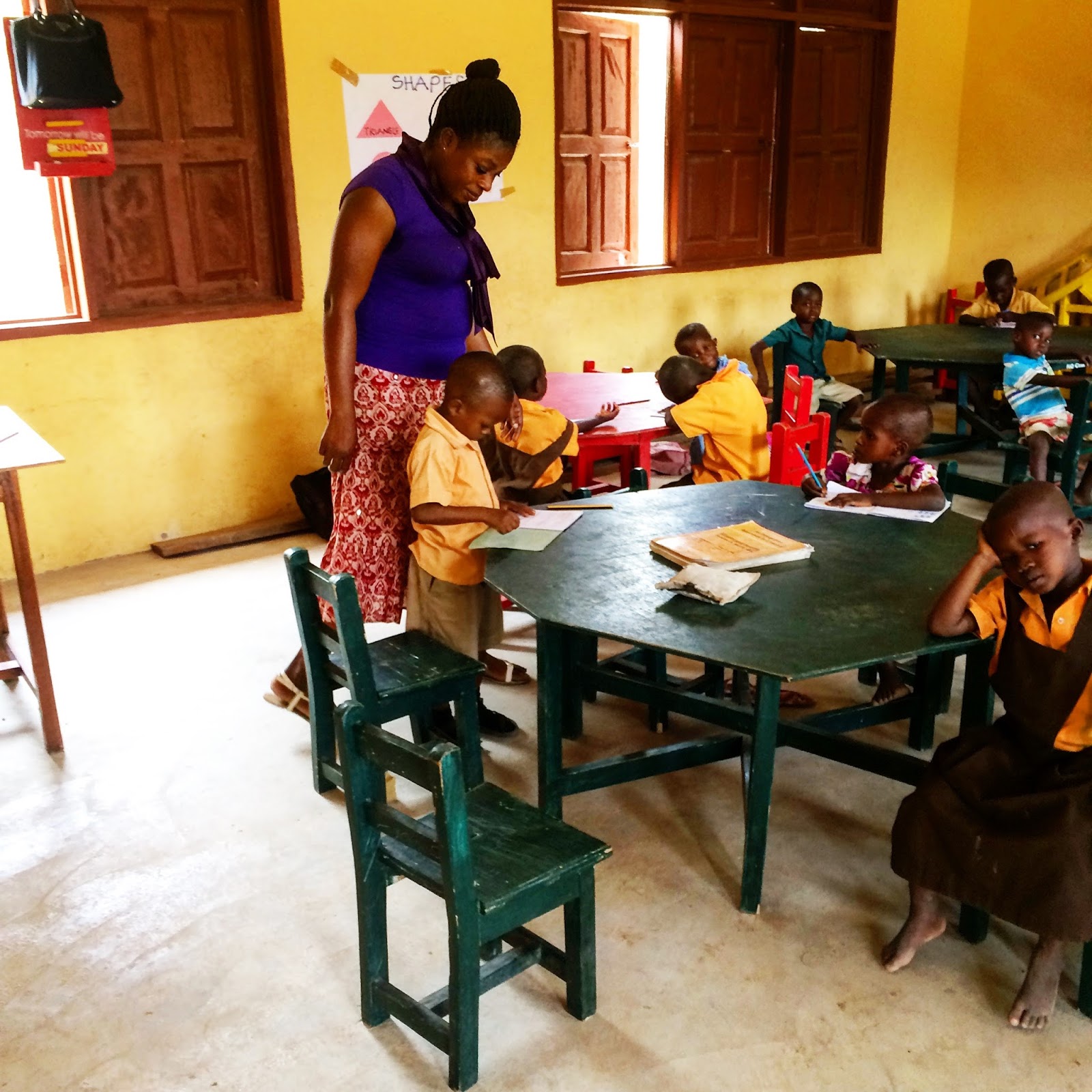
Rural School

Having a ‘servant’ made me feel uncomfortable, to say the least. I approached my colleagues and asked questions to my host family about the circumstances that would make this situation just. They told me that since she is able to attend school it is a way for her to pay her school fee’s and for that she is fortunate, that my house family were doing the Christian thing by employing her. In a country where the minimum wage is just under $2.00 Canadian dollars a day ( a day!), sometimes there is no other alternative. My colleagues tell me our maid was lucky to find work and should be thankful for it. I see it as a sign of a society still struggling cultural norms that counter their development.  

My main issue was that I was here to work in development with women. How could I work in development from one side and yet benefit from the labour of a child on the other? I realised that she is one of the lucky ones to find a home that allows her to study and work and is in comparison a happy environment for her to do so, the alternative is remaining in poverty and still needing to work as her parents could not support her. Her work further removes her from vulnerable situations that lead to child trafficking, child marriage, abuse and violence.  If I were to deny her work I would be the oppressor in this situation, so I needed to just deal with it and accept a culture different than my own.


When no one is around I hear her signing to herself, nursery rhymes, the national anthem, TV ads. I turn on the TV and let her pick the show she likes, she watches from the hallway never daring to sit on the sofa. I sneak her treats, offer her rides to school and make sure to clean up after myself not wanting to create any additional work for her. I mourn for the loss of her childhood as she is often alone and working without the freedom to play and be a kid and at the same time I celebrate her ability to educate herself and lift herself out of extreme poverty.  The issues are never as plain as it seems. I endeavour each day do show her kindness, offer smiles and speak to her as the beautiful individual that she is.

 XX Melanie


"It is vital that when we are educating children's brains that we do not neglect to educate their hearts" Dalai Lama


Monday, 20 February 2017

12 Things I Wish I Knew Before Travelling to Africa

Having been in Ghana a mere three weeks I still have a lot to learn about the local culture and customs. Yet already I become a little hardened to the traditions that effect me daily. Here is a list of things I wish I had learnt before setting out on my trip to Western Africa:

1.     You will stick out
·      I mean, I knew I would be noticed but it is hard to describe the level of attention I get at any given moment of my day. Obruni- is what they call white people, and I hear that word literally hundreds of times walking down the street, children’s mouths go agape at the site of me, women pull my hair on the bus and men are constantly making kissy noises to get my attention.  Even though I may not be the first Obruni they have seen, it is still uncommon enough to call attention to.
2.     Sexual Harassment is a cultural norm
·      Not only do the men gawk at me but they follow me down the street, tell me they love me and want to marry me on the spot and even grab at me. All these are apparently typical of the Ghanaian and even African man but only more intense to the stand alone Obruni who draws more men than usual. Being a solo traveller and a plus size women I am further targeted for my apparent wealth and birthing hips. Basically I have to get used to it, grin and bare it and stand up for myself when I think they’ve gone too far.
3.     Say hello to everybody
·      In my first week I learnt that everyone says hello, good morning, good afternoon, it is customary.  It has felt like I have been inundated with welcoming words to the point that they were overwhelming. Now I am being proactive and making sure to say hello first, people are generally more pleasant when I make this small effort and return with “you are welcome”.
4.     People are blunt
·      Ghanian's especially are somewhat blunt with realities we in the western world tend not to talk about openly. If you have a pimple on your face they will point it out, if your hair is messy they will pull on it and tell you, if you are overweight they will straight up tell you ‘you are fat’. Sometimes a waiter will notice I have finished my meal and say you are fat do you want more food, other times it is a child saying “you are fat, I like your face”. In any case it is a plain observation I have been hiding from my entire life and even though it is ingrained as shameful to westerners it is seen as a sign of wealth and excess here. Again, I grin and bare it.
5.     The food is spicy!
·      As a self-proclaimed wimp I am fully trained in asking for no spice when ordering food. Though everyone’s definition of spice is so varying I mostly look at what’s on the kids menu as a cheat to see what will have less ‘flavour’. This doesn’t work here, even kids can handle dishes that to me taste like pure hell fire released on my tongue. With tears streaming down my face I always try to push through, much to my digestive systems dissatisfaction
6.     Dress Up
·      Here’s me with my hiking boots and t-shirt, around me everyone is stylish AF! In Ghana, they take a lot of pride in their appearance and despite the heat everyone dresses sharp, especially for work. I immediately regret nearly everything I brought, and all my favourite dresses I left behind. It can also be seen as a sign of disrespect to dress down as it is perceived I do not deem the people worthy of the effort, hopefully the new dresses I’m having made will help my image.
7.     Learn the local languages
·      Even though they told me everyone speaks English, they really don’t use it for day-to-day chatter and in some of the rural villages I will be working in. I wish I had spent time before I came getting in a few more basics but instead I will have to learn as quickly as I can here.
8.     It’s hot!
·      Ok now you’re going, Mel, what were you expecting it’s Africa! But the heat is just constant and inescapable. I would have taken more consideration in the things I brought because things melt! My fabrics are too heavy; my hair needs to be up all the time and I need industrial strength deodorant!
9.     The Internet sucks
·      Though the average adult African has 3 cell phones the networks coverage is as sparse as the food is spicy (so lots!) Even uploading this blog can take an entire day, patience is a virtue to learn whilst you are here.
10. You will always be the outsider
·      Sometimes I feel like the people I work with would have preferred a monetary contribution over having me, other times I am overwhelmed with their gratitude, either way I am always cognisant that I will never be fully accepted by the locals who sometimes hold a bit of resentment for my presence.
11. Friends back home will forget you
·      Not on purpose, but soon enough everyone will move on with their lives and forget that you are isolated on the other side of the world with hardly anyone to talk to. Those few calls or messages I get count a million times more when the long days of solitude are broken up with friendly voices.  
12. You will question your intentions
·      I am constantly checking my motivations for being here, questioning its validity, quietly chastising myself for coming.  Will any of this matter? Have I just fallen into the very same stereotypes I’ve been trying to avoid? Am I just another white girl on a voluntourism trip to Africa? When everything else weighs down on me I think about how hard I need to work to prove it all wrong and how much of an impact I can hopefully have with the people I work with.  

All the best until next time,

Melanie XX

Friday, 27 January 2017

Ghana Girl


Bussels Airport
From 12,000 meters in the sky I write en-route from Brussels to Accra, Ghana. Last night we passed over Greenland and I saw the northern lights for the first time ever. I think staring at the shimmering green lights I had a moment of realization, it had finally sunk in that I was moving to Africa for a year. It wasn’t when I had the 7 vaccines, or the 6-week wait on my visa or even trying to fit my life into one backpack. This was really the point of no return, and my whole world was about to change.

After my last contract I decided that I wanted to do something a little different, I wanted a challenge, something to shake me up and something outside of my comfort zone.  I am young, single, and able bodied and now with a degree I literally have all the privileges and opportunities in the world. I wanted to offer what I am and what I have to the rest of the world and I wanted to do it as a volunteer while I could still afford to.  Using my experience in agriculture and business I will be working with women farmers in a rural area to improve their processing and distribution while increasing their individual and community food security.

For some reason I always had a quiet dream to live and work in Africa one day. I usually shrugged it aside as a childish pipe dream, never really thinking it would happen but secretly always wishing for it. I don’t know what it was that attracted me to Africa other than the total unknown. It never really occurred to me that my degree in environmental studies would take me where I had always wanted to go.

Women's March-Ottawa
To tie everything in together was the motivation I gained from the recent women’s marches on Washington and around the world. This highlighted for me the need for us women to work with and for each other. It is only through improving women’s lives around the world that we will gain equality. After the march I attended in Ottawa there were presentations and speeches, one in particular by the managing director of Crossroads International (coincidentally or not the organization sending me to Ghana) stood out to me. She spoke about the work they were doing across the developing world to further women’s rights and empowering women and how many places still had a lot of work to do to rise to the level of our western ideals. Tears streaming down my face it was as if I was in the right place at the right time to hear her message, and I was going to do the work that was needed, the work that was driving the women’s rights movement.
In Flight Ice Cream!

Lunch is being served now, the plastic cutlery and disposability of air travel reminds me how many emissions I am producing by my journey, but the lifestyle I will be leading will be very different from the wasteful North Americans I think. Time to travel to a place where the 100-mile diet is less of a new age fad and more of a way of life. Where you shop at farmers markets for everything not just luxuries and where a slower pace of life will quiet my mind and allow me to take it all in.

Much love,

Melanie 


"To travel is to live"- Hans Christian Anderson

If you would like to support my work or learn more see my funding page here: https://cci.akaraisin.com/pledge/Participant/Home.aspx?seid=2478&mid=9&pid=3045663