Showing posts with label Locavore. Show all posts

Monday, 5 March 2018

Should you volunteer in Africa? (the answer may surprise you)


Rice trials with the regional minister of Ag
I spent last year in rural Ghana working on women's economic development projects with a Canadian NGO. In the beginning I was a little naive in thinking that I had found an organisation apart from the rest, above the issues typical in development orgs and that it would allow me to fulfil a lifelong dream of building a career in Africa. But what I learned was that there are some serious issues with traditional development, something I thought I knew but failed to acknowledge. There are also amazing people doing really meaningful and effective work. It is up to us to dig through the noise and find the gems doing the good, honest work that will affect change.

The question remains, should you volunteer in Africa or the developing world in similar roles/ agencies. No, I would not recommend it. But do I have any regrets and would I do it all over again if I could? Probably, because I didn't know any better until I had experienced it for myself. It comes down to, do you want to support a system of ineffective projects based on colonial models of development?

These big agencies peddling volunteer positions do have a great sales pitch to pray on those of us wanting to share out skills and time for good. They also lead us into thinking we are somehow capable of achieving feats the previous volunteers were unable to. They get their funding from governments and large corporate grant programs that enable them to continue the cycle of raising funds to perpetuate their ability to raise more funds. Unfortunately, a very limited amount of this money actually reaches the beneficiaries of the projects and the bulk of work is lost in over inflated reports amplifying little success and sweeping major issues under the rug.  There are smaller grassroots groups that I interacted with that created projects by locals that supported locals, if I could do it all over again I would align myself with them.

Women's group showing their first harvest
My role was as a women's empowerment adviser but I found that the organisations we were partnered with were furthering the problems of gender inequality with widely tolerated and accepted patriarchal structures and little in the way of training or understanding to counter this. They heavily relied on funding from our positions to pay salaries and apart from this it didn't seem like they were interested in the projects success. This was a big issue for me. Since leaving Ghana the women I worked with have had little to no contact with the organisations, and no more support. We were doing development for developments sake and not apart of a sustainable structure to promote actual change.

So if you too are interested in going abroad and spending your time volunteering, please do it. Thank you for your dedication to others and for sharing your time with the world. Here are some helpful tips to get you heading in the direction of a truly meaningful experience for you and those you endeavour to support.
  • Shop around, find out if other organisations are doing similar work in the area, is that good or bad? 
  • Learn about sustainable development research and projects happening around the world. Does your organising follow those practises? Do you share similar values? 
  • Ask hard questions, like how many volunteers have left early, issues with the locals or organisation? Have past projects been effective, is there any proof of this? DO THEY NEED YOU?
  • If you need to pay to volunteer it is potentially a voluntourism scheme in disguise, however grassroots groups with limited funding expect you to pay your way. Be critical in your research, where does the money go, where do they obtain funding? 
  • Peace and Love Women's Group
  • Can a local do this job better than you? In the village next to me there were four 18 year old German's teaching English at a school. They receive a modest 100 Euro allowance a month and have no experience and basic English themselves.  Couldn't sponsoring a qualified local teacher be more appropriate? Are you needed? 
  • The difference between a volunteer and an employee are often blurred. As a volunteer I was paid a monthly stipend of up to 10 times my local colleagues. Yet, I was still considered a volunteer and by Canadian standards I made less than minimum wage. This difference however has the effect of de-legitimising work that a paid professional might have and furthering the pay inequity of locals and expats. 
  • Is your organisation present. Are they accessible to you, are their other staff/ volunteers on the ground? My NGO had other volunteers in Accra and a support staff but unfortunately I was the only one in a remote location. 
  • Talk to previous volunteers. I read blog posts from previous volunteers but didn't reach out until after I was in the country. Some of the issues they described helped me legitimise my own personal struggles with local conditions and staff and was not something you could easily pick out from social media pictures of smiling folks. 
  • Does your organisation share information, is it transparent? I had little to no idea about other projects they were involved with nor about previous projects in my area. I felt like they were hiding the amount of failures in order to maintain positive image and recruit new funders and volunteers. Ask, ask ask! 
  • Research your org! Use sites like Charity Navigator to find out how much money is going into projects and how much is paying for over inflated salaries. Be proud of the organisation you give your time to.  
Saying goodbye
Bottom line is this: I have come across some amazing volunteer opportunities at home and abroad. There is real potential to help drive impact and with the right skills and the right organisation you can probably help in some measured capacity. So be realistic with what you can achieve in a 2 week, summer or 1 year contract in the developing world and do the research to find the right organisation for you. Volunteering really does change your life for the better, get out there and be the change you want to see in the world.

If you are looking for volunteer projects in Ghana here are some cool ones to get you started:
  • Dunk-Providing after school and athletic programming to kids and youths 
  • Global Mama's - Fair trade, women powered goods that take volunteers and interns
  • Hipsters of Nature- "Greening Ghana in style"
  • Humanist Association of Ghana- Secular support to protect human rights and promote critical thinking. 
  • Farm Radio- Supporting broadcasters in developing countries to strengthen small-scale farming and rural communities. 

More about my recent volunteer project in Greece with refugees soon!

Love,


Melanie XX

"Volunteers are paid in six figures...S.M.I.L.E.S" - Gayla LeMaire 

Wednesday, 12 October 2016

Murder and Meat Mondays

Over the past couple of years I have been on a journey of self discovery and learning about a how to make the food system more sustainable and just for everyone. One of the pieces that I have struggled with is to eat meat or not to. I have been a vegetarian for the better part of 14 years (as described in this post), and have always toted "if I can kill it, I can eat it" as my reasoning behind abstaining. Living in my little corner of heaven on Vancouver Island I am on an organic farm, next door to an organic farm, free range- grass-fed beef farm and an artisan cheese making dairy with SPCA certification. What a place to be for a local food lover.

The Neighbours have been raising 150 unsexed chicks which meant a bunch of unintentional roosters were produced. Working there I saw them butcher a couple a week to eat, they had to be disposed of because too many roosters is a very violent place for chickens. I understood that this was humane, the meat was organic, the animals free run and happily clucked about their days. So why shouldn't I eat this meat?


Because I was given the opportunity and was able to watch a few being processed I worked my way up to be the actual executioner. The knife was placed in my hands and I sawed off its head after a few minutes of squirming. It wasn't pretty, but I got through it. I helped pluck the feathers and the farm roasted and spiced it up. Later I was presented with a piece of chicken,  it could have been any old piece of meat but this time I was responsible for its life. It tasted, a little tough to be honest. I had never tried rooster before but kept seeing the head while I chewed him up. As a recovering vegetarian it was a very odd experience for me and I didn't 100% enjoy it. In the next few days I would work on the leg piece I was given but my body rejected those foreign enzymes I wasn't used to and I was a little sick. 

I tried again soon after, I went for back-bacon from the neighbours freshly butchered hogs, the ones I had personally delivered from the butchers. This time it tasted rather delicious but again my body unaccustomed to any meat was being over loaded and let's just say, that week was a bit icky. Having access to good, local food has definitely been a game changer for my diet and stomach.

Now, I am not about to hit a drive-through and order an unidentifiable cheeseburger any time soon, far from it. But instead, I am incorporating meat into my diet that is local and sustainable from trusted and known sources. I was recently given a meat bonus from work (I know right) that is ground beef from one of the older dairy cows. Other than being the coolest job ever it also means I am using an animal who's meat is not highly valued in the market and using it to its full extent.

I would rather support the industry of small, organic farmers, treating animals fairly and butchering good, sustainable meat sources than revolt an entire system that is other wise a natural part of the human diet. Being a vegetarian ignored so many parts of life that involve animals. Most shoes have leather pieces, cheese has rennet from cows, agriculture is responsible for eco-system destruction and deforestation. At the end of the day all the food we eat negatively impacts the lives of animals and the world around us and none of us from vegan to carnivore are innocent of this. So a balance must be struck. I have a problem with the industrial food system and not small farmers and it is important to remember that.

In the end, support what kind of food you hope everyone can eat one day. For me that is farm fresh and local that includes organic produce, meats & grains. And everything in moderation, Meat Mondays!

In good food,

Melanie


Monday, 3 October 2016

Post-Summer Update

Goldstream Provincial Park

After a few months off I am back and eager to catch everyone up on my summer and new post grad life! I have left my personal bubble of the university that was a safe space filled with like minded individuals. I have found that the rest of the world has a lot of things to catch up to in their ways of thinking about the environment and sustainability, sometimes frustratingly so. Never the less my new home on Vancouver Island has proven to be a bit of a hub of local food loving and conscientious  people. Be it the burgeoning young farmer and agrarians groups or the musicians and yuppies, people seem to generally agree on one thing- Local food is the bomb diggity! While some of us preach the word others are in the trenches building the foundations of our future food system. I salute you fellow foodies and I beg you spread like wildfire across the landscape.
Chickens!


So many exciting things happened this summer, here is a quick run down:
  • I eat meat! (post coming soon!)
  • Vancouver Island
  • Organic Farming
  • Chickens! 
  • 2 jobs
  • Farmers Markets 6 days a week
  • Moving (again!)
Hard at Work 
This summer has been the most local loving yet and I had a blast doing it. Though my summer contracts are finishing up and I am looking forward to moving on to new projects in the winter months and a bit of a break in between. 

Stay tuned for the next exciting chapters!

XX Melanie

"Progress is impossible without change, and those who cannot change their minds cannot change anything." -George Bernard Shaw


Wednesday, 4 May 2016

Graduated!


After what felt like 3 very long years, I am finished my undergraduate degree! My time at school has been filled with volunteering, activism, work and a whole lot of learning...most of which I could attribute to outside of the classroom. I learned the most from the activities and work I did with the University Farmers Market, PGPIRG and working with Meal Exchange that will apply to my life outside of school. The fancy piece of paper that I will be paying off for the foreseeable future may not be what I anticipated going into University but the experiences I gained are invaluable and I don't regret for a minute returning to school. For me it was a time of self-discovery that allowed me to explore my interests and build skills. Everyone has a different experience at the end of the day but for me it was the right time and place to continue on this life long learning adventure. Go to school, don't go to school and you can still learn to be a better person, citizen and neighbour to those around you.

Having fast-tracked through a 4-year degree in 3 years time while working multiple jobs and being really involved, I am exhausted. What are you going to do with an Environmental studies degree was the biggest question I asked myself this year. But without missing a beat I packed up my worldly processions, (having given away most of them) and moved down to Vancouver Island. I am relocating to the Nanaimo/Parksville area to work on an organic farm for the summer. After going from a fast pace environment in Toronto, to a busy bee in Prince George I will now be moving at a slower pace in the country side. This presents both challenges and opportunities for me to explore the kind of lifestyle I want to lead and ultimately discover what will allow me to live simply. This area boasts lots of fresh, organic produce, tons of farmers markets, ocean access and a more southern climate. All of these things make me feel like this is the place for me, for the next little while at least.

This transitional time has also been very disruptive to routine and when you travel you are forced to explore communities to find local, sustainable options again. Leaving my comfort zone in Prince George was at first a welcome idea but I already miss knowing where the fair trade coffee is everyday. I also bought my first car, begrudgingly, to move with and drove more in a week than I have in my entire life. I am on a month long vacation and off to Europe to celebrate in the least environmentally way possible by taking a cruise. I will spend the rest of the summer working off my carbon emissions and negating the impact of this month's movement.

These changes will hopefully turn out for the better but only time will tell what is next on this journey for me, work, grad school, life? For now I will continue eating locally, reducing my impact and enjoying life.

Lots of Love,

Melanie XX

"You are educated. Your certification is in your degree. You may think of it as the ticket to the good life. Let me ask you to think of an alternative. Think of it as your tickets to change the world."  -Tom Brokaw


Tuesday, 8 March 2016

Freeganism or Veganism?

Since eating locally has no longer been compulsory in my life after completing my year long challenge, I have been experimenting with how I eat. At times I could be considered vegan. I don't eat meat, cut out eggs and dairy and eat way too many carbs. At times I think I am more vegetarian, opting to buy eggs from a local farmer or cheese when I've met the cow (or goat). Always I am a locavore, choosing to buy local whenever possible and choosing not to buy at all when it is not.

Leftover Ice Cream at the UFM
I do, however, have a confession to make. I've been a vegetarian for 14 years, but last month I ate bacon... and I'm kind of ok with it (after I stopped being violently ill). I know, crazy right! I'm not slipping off the veggie wagon or anything but I am evolving my diet slightly to include meat and dairy. Instead of centering my diet around what I won't eat or where I won't eat I've decided to include food waste reduction as a priority.
Think about all that extra energy that goes into the production of meat. Even though it is the smallest representation of food waste, it is also responsible for the highest emissions (read more here). And after all that goes into its production, from calf to cattle to butcher to processing, can you still justify throwing it out? I am having a battle with my morals on this one, seriously. But I have tried to look at it as an overall goal of reducing harm to the world. I am not creating demand for meat, I am not participating in the production of meat or advocating on its behalf. I am rescuing food that is destined for the garbage bin. Ensuring that at the end of its life cycle the final product was being used for its intended purpose and not contributing to more harm by rotting away in a landfill.

When I chance upon food waste I can be freegan, eating whatever is bound for the bin, be it animal, vegetable or mineral. Just to be clear, I am not going to go on record as a meat eater because, gross. But I am admitting to dumpster diving and leftovers-taking and I am feeling pretty good about it. Every little thing helps in the food waste fight right?

What I am realizing now is that my battle is not with the label I choose to define my eating habit but with ethical consumption. I want to feel good about the choices I make and the food going into my body. What I know is that labels suck, and they don't work for everyone. Am I a vegan? Sometimes, mostly. Am I a freegan? Free-food-eater, yes. I hate food waste. Am I a locavore, yes. Ultimately I prioritize local with all my purchases. Is there a label that applies to me? No, not really, but can we not all just become ethical consumers and make good choices everyday?


In good food,

Melanie XX

Tuesday, 22 December 2015

8 Ways Your Diet Can Reduce Climate Change

Global Climate March- Prince George, Nov 29
With the world's attention on climate change at the recent COP21 conference in Paris, I thought it may be interesting to look at how climate change and food are related issues. A lot of attention has been spent on the big, bad fossil fuel industry but did you know meat production burns more fossil fuels than all the cars on the road combined? Agriculture itself is responsible for up to 30% of all emissions, so changing the way we eat and think about food can help fight global warming!

But what can you do? Making simple changes as a consumer and eater (which we all are) can go a long way if we act together!
  1. The first thing you can do to reduce greenhouse gases and slow climate change? Lose the meat! I am not saying everyone needs to become a vegetarian or vegan, (but that would be great) but even cutting back to one meal a day with meat can make a big difference! Why not try Meatless Mondays?
  2. Go Local!!! As this blog title advertises, shopping local is the best! Buying local products will reduce transportation and processing associated with imported foods. Check the local section in your grocery store, read labels, or shop at the Farmers' Market! 
  3. Buy Whole foods. They will be less packaged, have fewer additives, be less processed...less can be more and it is overall healthier for you! 
  4. Grow your own food! Why not cut out all those middle people, transportation, and waste and go straight to the source by growing your own veggies? Just $1 in green bean seeds can yield $75 worth of produce! How's that for a money saver and planet saver?!
  5. Eat in Season! Eating in season goes hand-in-hand with shopping locally and growing your own food, and will reduce energy and transportation normally expended on your meals. 
  6. Food Waste is not sexy!
  7. Choose Organic. Organic food is produced with fewer chemicals, no artificial hormones, healthier soils and supports a better agriculture system that can feed the world.
  8. Don't waste it! Throwing out food that has already gone through so much to get to your plate is a travesty.  If after all that production, transportation and manufacturing occurs, food is wasted, we might as well leave our cars running all night long for the rest of our lives, too! Don't throw out the energy, time and resources by buying only what you need and taking leftovers home.
  9. Compost veggie scraps and leftovers. Instead of scraps going to the landfill, they will break down in your home composter and make organic fertilizer to grow your own food! Win-win! 

Vote with your dollars and show how we, the consumers, are the ones in control of the demand and will ultimately fix the broken food system we have created!

In good food,

Melanie

"Getting the whole food system to change is a seriously big challenge. But one thing is clear: no change in food means no gain in climate change prevention."- Rebecca Wells & Tim Lang


Wednesday, 2 December 2015

Guest Blog: Meal Exchange

You can find my guest blog at: MealExchange.com

 
I was born and raised in Ontario in Ottawa and Toronto where concrete jungles were my playgrounds and food came from packages at the grocery store and we hung out at the mall on the weekend. I loved shopping at the farmers market, biking to work and thrift shopping, but these things were money savers and I never considered my greater impact on the world I inhabited. When I was planning on returning to school I knew I was interested in the environment but I never realized that in a few years my entire life would be changed by studying it. I chose UNBC for its small class sizes, geographic location AWAY from home and because it had a Farmers Market that I thought would be fun to be involved with.

I began volunteering with the University Farmers Market and applied for a position as the Development Assistant. I didn't get the job but soon took on the role of Volunteer Coordinator that I was able to apply as an internship towards my degree. In my second year I was voted in as chair of the Market Committee. Now I am the Market Manager, in charge of the market that inspired my interest in food studies. Working at the farmers market provided me with connections to other things happening in the food system and allowed me to understand the bigger picture issues like food insecurity & food justice. 

I started eating local, ethical foods and thinking about my consumer behaviours. I spent an entire year eating only from the farmers market just to test my resolve and solidify my feelings towards food. This wet my appetite for other works surrounding food on campus. I became involved with the PIRG on campus and was hired as the Local Foods Coordinator organizing a monthly good food box  and sourcing local coffee and eggs. I started gardening at home and soon became the PIRG gardener on campus and started a market stand in the garden over the summer to sell fresh produce to the UNBC community.

I was hired as a coordinator with the Campus Food Strategy Project through Meal Exchange in 2014. I now had a network of food activists at my disposal and it was great to connect to something larger than our little campus. This has launched me into a research project on food insecurity that I am just sinking my teeth into. We were also able to start a food recovery program on campus rescuing food from the cafeteria and donating it to meal programs in the community. Since we began we have saved over 2000 lbs. of food and are looking at other strategies to build a campus food bank and expand the program to other campus's across Canada.


Who would have thought this city slicker from Toronto would morph into the die hard foodie she is today. Nearing the end of my degree I begin to worry about who will take my place here on campus. Having taken on so many roles I worry I will not be able to find interested students to continue the work that I have stewarded during my time at UNBC. But I know whoever takes over will have a wealth of information to take on from mine and my predecessors experiences and from the connections of our national network of dedicated students with Meal Exchange.

In good food,

Melanie XX

"Without food, we cannot survive, and that is why issues that affect the food industry are so important. " - Marcus Samuelsson

Wednesday, 4 November 2015

Life after Locavore


It is interesting to think it has been two months since my local living challenge was completed. What has changed for me since then...not a whole lot. I still do my weekly shopping at the farmers market, still thrifted my Halloween costume and still support local business. The only difference is now I choose to do so out of my own free will instead of needing to for a project.

Cabbage Catch-of-the-Day
The first time I went to order a drink I was struck with the notion I could now order anything I wanted, the power of choice was entirely my own for the first time in a year. I looked at the myriad of drinks on display, read the drink menu and even consulted the bartender for ideas. In the end I ordered the same thing I had been ordering all along, the local beer on tap. For all the choices and freedom I was now experiencing I had something else nagging me at the back of my head...a conscious. I had rather un-deliberately set myself up for a life of conscious decision making.

So what does this mean for my future and the choices I will undoubtedly need to make?

Wild Mushrooms from the Market
When I was entirely local I heard about local ice cream being sold at the 7-11. Locally sourced Ice Cream from a corporate chain was one of those little annoyances I used to abhor, now I weigh the pro's and con's carefully before making my choices. I shop expiring items at the grocery store, yet still have only ventured there twice this year. I browse the local section at Save -On and still buy from producers directly. I make choices based on my values and then feel comfortable with my decisions. and that's what i hope if anything others can learn from this experience. You don't have to bee 100% local to understand why local is important but you do need to act on the values that you preach to others.

So let's live more honestly, make better choices for ourselves and the environment and be authentically ourselves.

Love,

Melanie XX

"You are free to make whatever choice you want, but you are not free from the consequences of the choice." Ezra Taft Benson


Tuesday, 6 October 2015

A Day in the Life of a Market Manager

Market Twinsies!
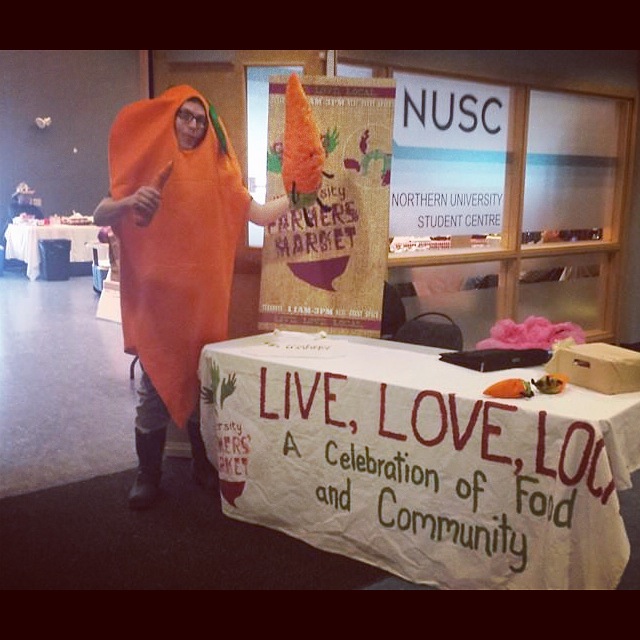
One of my jobs, the one I could even say I love the most, is my position as the Market Manager at the University Farmers Market. When I was looking at schools for my undergraduate degree, one of the pulls to the University of Northern British Columbia was access to a farmers market on campus that I had a goal to be involved with in one way or another. In my first year I volunteered every week setting up tables and helping vendors load their goods and became the volunteer coordinator. In year two I was voted in as the chair of the committee and helped with everything from events to wearing a carrot suit when needed. Now in my 3rd and final year I have taken over as the manager and am putting my experience and passion to use every week.

Though the UFM runs Tuesdays from 11-3pm during the school year there are still lots of things happening before market day from organizing special events, to coordinating layouts and finding new vendors. The main event for me is market day. Here is a look at a day in the life of a market manager on a typical market day:
Harvesting in the PGPIRG Garden

7:00- The mad dash begins as I catch the first bus up to the University to begin my day. My first order of business is to get to Campus in time for a quick shot of coffee from Degrees Coffee Co to get me through the busy day ahead.

8:00- As I was also the gardener for the summer, harvest time is still in progress. I arrive at the PGPIRG Garden as early as possible to pick and wash the weeks ripe vegetables to bring to sell at the UFM.

9:00- Set up begins in the NUSC event space that houses our weekly market. I arrive before volunteers and prepare the space for vendors to arrive. Set up may seem similar every week but behind the scenes a complicated game of Tetris is happening with vendors preferred spaces, last minute cancellations and purposeful placement of each type of goods fighting it out with weekly special events for the ideal space.

The Market Before Vendors Arrive
10:00- As volunteers arrives to help we meet vendors at the loading docks and load their goods onto carts. Volunteers then head to the market and I assign them their table for the day.
As I learnt from our first market we need to carefully map out who is using which outlet to make sure we don't lose power, which happens more often then you'd think.

11:00- The Market opens to the public! As eager customers begin to trickle in last minute set up is still going on. There are always a few late arriver's that need a bit of help getting going and I rush around the room to ensure vendors have every thing they need to get through their day, be it small change, an extra chair or even a coffee.

Market Time 
12:00- The rush hour is on and we see a few hundred people through the market during the busy lunch hour. I make sure there is enough change for jams and kale and answer questions to people coming through. As it is my third year at the market there are a lot of familiar faces and I always try to say hello to everyone.

13:00- As the peak traffic time ends a slower paced market atmosphere emerges and more people lounge in the chairs and chat with vendors. I take this opportunity to visit each vendor to collect weekly table fees and do my personal shopping at the same time.

14:00- If it is quiet enough and everything seems to be running smoothly I indulge in a 10 minute back rub from Kathy at Relax-in-chair. A guilty pleasure, which I have never regretted.

15:00- The second the clock strikes three the mad dash for carts to leave begins. Unlike the morning as vendors trickle in over an hour the exit is much more instantaneous. Volunteers struggle to get carts fast enough to meet vendor itching to get back to the farm or pick up their kids.

Crunchette the UFM Mascot
Oh no! We find a cooler with sausages left behind by a vendor and call them straight away to let them know we have them and arranging pick up for the next morning. Sometimes if we are lucky someone leaves a sweet treat for volunteers to thank them for their much needed hard work that day. Other times I buy cookies to show them how much we love having them around!

16:00- Accounting is finished and we deposit revenues for the day at finance before they close at 16:30. Clean up finishes and we make it so it looks like the market had never happened.

17:00- At the end of a busy day I am always thankful the Thirsty Moose Pub is our neighbour (and another job of mine). Once everything is tidied and the last of the tables are taken down I grab a chair at the bar and sip a local brew to finish out the day.


As you can see it is a busy day full of challenges and there is never a dull moment. It is a happy place to work, a place full of good food, homemade crafts and lovely people. I wouldn't trade it for the world.

See you on Tuesday,

Melanie

"What makes the farmers market such a special place is that you're actually creating community around food." -Bryant Terry


Thursday, 17 September 2015

The 5 More Times I Failed at Being a Locavore

I originally wrote 5 Times I Failed at Being a Locavore but have since needed to add to that list.
Here are 5 more times I slipped up and purchased outside of my BC region:
  1. Sim Card
    • I bought a used iPhone 5 and thought I could just cut down my sim card to fit into the new smaller model... but it turns out it is a different card all together, so I had to buy a new sim card from Telus to go with the new phone. #fail
  2. Drinks
  3. I don't think that bucket of
    alcohol is local....
    • Those drinks my friends bought me at the bar in return for me buying dinner was a total cheat of the system, I admit it, I failed, it was the alcohol talking. 
  4. Greyhound
    • If you can't find a ride you can't go...should be my new rule but on planned holidays sometimes you have to bite the bullet and pay for a bus. It is better on emissions then a flight and at least I don't drive myself however I recognise that greyhound is an international company and therefor makes this list. 
  5. VIA Rail
    • Trains are the most sustainable way to travel cross country. I went to a conference in Toronto and then hopping over to Ottawa for a quick family visit before the school year. Travel in itself should be off my list if I was 100% local but sometimes all the sacrifices you make during the year will hopefully help you offset the annual pilgrimage to visit your parents. (You can hear about my trip in this post- VIA: The more (in)human way to travel?)
  6. Medicine
  7. Vancouver, BC- Natures Medicine
    • In general I try not to take medications whenever possible. I stopped taking Tylenol for headaches or arthritis pain (yes, I have pretty bad arthritis for my age) instead trying to live through the aches and using natural remedies. However, once this year I was so sick that I broke down and bought cold and flu medicine from the drug store. In my defence I chose a small independent pharmacy in town and bought the no name product...but I still felt like a failure for needing drugs. Full disclosure over the year i bought, one back of Fisherman's Friends, cold medicine, and a prescription inhaler... 
Cheers to making mistakes and learning from them!

Melanie 

"A person who never made a mistake never tried anything new."- Albert Einstein

Thursday, 10 September 2015

What I Learned from A Year of Living Locally

Can you believe it has been an entire year since I switched to local? That is a year of supporting local businesses, eating delicious local food and discovering hidden gems close to home.
Ryerson University

In one year I...
  • Lost 20 lbs 
  • Paid off all my credit cards (How I Paid off my Credit Cards by Going Local)
  • Learned how to make cheese
  • Learned about the food system
  • Discovered local business's
  • Became a gardener
  • Went on the local radio and news
  • Learned about myself
  • And spread the word of local

There were times when being a Locavore felt socially isolating but what I learned from this experience far exceeded any of the personal struggles I faced. I learned that eating local is just the tip of the iceberg of things we can do to live more sustainably. My eyes were opened to the flaws in the food system that became more obvious when I took the time to learn about my food and what I was consuming. And once you have been wisened to the ills of the world, it is difficult to ever go back.

"Live simply so others can simply live."- Mahatma Gandhi
Un-Local Night

I learned that I have changed, even if the world around me has not. I recently visited Toronto for the National Student Food Summit and was disillusioned with a city that used to feel like home, instead it felt like an urban sink hole where all the problems of society seemed to flourish. I know now that I can carve out the kind of life I want by making decisions every day that will benefit me as well as others.

My first week of un-local-ness culminated with a blow out un-local night at Earl's Prince George with friends. When the cloud in my head lifted the next morning I understood that though it felt good to be bad I still had a guilty feeling left over, a feeling I could be free from as an ethical consumer.

I am a Locavore, I am a Freegan, I am a Change Maker.

Cheers to the end of a great year, and the beginning of a lifetime of local living.

XX Melanie

"Be the change you want to see in the world." -Mahatma Gandhi

Monday, 24 August 2015

VIA: The more (in)human way to travel?


Saskatoon, Saskatchewan
Last year I took Via rail from Jasper to Toronto for my annual pilgrimage to my homeland and to attend a conference at the same time, the view was beautiful but the service was discriminatory and pretty awful. This year  I decided to give it another shot and was joined by my sister from Vancouver all the way to Ottawa. This nearly 5 day journey would be made even more daunting by adding the budgetary restraints of students which meant we could only afford coach seats and not cabins. For 4 nights we would have to eat, sleep and live in our chairs only venturing up and down the cars for the occasional stretch and exploration. 

The classes are divided by the seating, service and physical compartments of the train. We in coach sat at the front and had access to the cafe and viewing car by day and the dining car by reservation for hot meals. The us and them perspective of the train had me thinking about what type of people would be using this mode of transportation. In the cabins it seemed to be largely retiree’s and upper middle class families that could afford the $1000 to 10,000 cost per person for a luxury cabin that comes with a sleeping surface. 

Mount Robson, BC
At least once I planned to go to the dinning car for a nice meal. When I entered the dinning car with my sister for breakfast once morning we were immediately addressed as economy class passengers in front of the other passengers, to clearly define our status to them. We were then asked if we understood that this meal would be more expensive then the canteen in our area of the train and asked if we could afford it.  I was like "WHAAAAAAAT!" The obvious display of classism was never more apparent to me then in this moment and I wanted to leave immediately but instead forced my way through a breakfast that seemed so unappealing. I am not ashamed of my poverty, being able to afford a train ticket is a luxury in itself and should not be under valued. Our service was inferior to others and the constant glares from the other passengers made the rest of the meal really uncomfortable.

The train is supposed to be the most sustainable mode of travelling cross country with less emissions then a plane or car journey. And yet I couldn’t help but feel as if I was on a cruise ship dumping waste at every port and living extravagantly. Every meal in coach is served in a styrofoam container and there very little recycling. VIA contracted out their meal planning and catering years ago to a corporate model so poor food quality and heavily processed ingredients are a standard on board. Sure we expelled fewer emissions but the waste that was produced in the 5 days of the route we were on might surely make up for any initials carbon savings.

Somewhere in Ontario
This combined with the obnoxious and elitist service makes me questions the slogan "the more human way to travel". I secretly dreamed of becoming the VIA rail sustainability manager and leading them down a path of greener choices. A business however established must constantly be engaged in strategies to be more sustainable if they want to continue in the future as environmental compassion begins to trickle into the main stream. 

Like last year I left the train with a bitter sweet taste in my mouth and 8 hours behind schedule. I had enjoyed the view but was left with too many gaps in my mind to appreciate the journey. As a locavore I took the train instead of a flight as it was the exception we made to travel as long is it was not a personal vehicle or flight it seemed more ethical. I love taking trains, I will most likely continue using them as my transportation of preference, however I am not certain I will choose this service again.

But at least now I have made it to my destination, Toronto, Ontario which I am here to attend the National Student Food Summit with Meal Exchange for the weekend. If have places I should check out in Toronto or Ottawa let me know by Twitter @melaniejadea

XX Melanie

"But I complain about the police the way the rich complain; not the way the poor complain. The difference is everything." Aravind Adiga, The White Tiger 

Wednesday, 12 August 2015

7 Non-Local Things on my Shopping List

With only a few short weeks until my year of living locally draws to a close, I am going to be sad to leave the Locavore challenge behind. I have nearly made it through an entire year of no Starbucks, no new clothes, no flights and no rum...and I survived! I found these things don't seem to be missing from my life and have evolved past them becoming more self sufficient and conscious along the way!!! Hurrah!
There are however a few things I have been anxiously awaiting to purchase once my term is complete September 1st, here is my list thus far:
  1. New shorts
    • My long lost backpack
    • I need new shorts for biking and haven't been able to find a suitable pair used. You could add biking gear to this list as there are a few things like and air pump and winter tires I have been waiting to buy.
  2. Backpack
    • My own backpack was stolen from me this year (Letter to a thief) and I have been borrowing a friends until I can purchase a new one. That bag came with me when I lived and travelled Europe and moved me across Canada. An investment in a new bag will hopefully last me for another 10 years. 
  3.  Coconut oil
    • I managed to make it through the year while going through my giant Costco sized coconut oil tub but I am almost out and can't wait to buy more. I used this sh*t on everything, I cook with it, brush my teeth, moisturise, make my own sunscreen, makeup remover, condition my hair. I love the stuff and don't want to live without it anymore.
  4. Birkenstock's
    • Totally ordering shots!
    • Last year my pair died after 4 years of faithful service and I am really excited to buy a new pair of quality shoes that will last just as long. I will be shopping from their vegan line and investing in quality shoes that will last beyond their aesthetic qualities. 
  5. Lingerie
    • Though I have been mending my undergarments at home some of them are on their final stretches and I am counting the days until I can replace them. My underwear drawer has been added to with handmade panties but I am needing a bit more support in the upper torso region ;) 
  6. Fly
    • I want to start flying again! I managed to travel this year going to Vancouver (x2), Seattle, Victoria, Nanaimo & Terrace by ride-sharing and am taking the train to Ontario soon to visit family. A year without flying hasn't been so bad but I do have the travel bug and am itching to get on the road again...er in the skies.
  7. Mascara
    • I want this shirt too! 
    • I finally found my one true love mascara and haven't able to buy it this whole year. I tried homemade versions, Lush cosmetics and going au naturelle but am eager to replenish my fresh face staple.

The end is in sight, and once I stock up on the non-local "essentials" I feel like I can go another year of local! (...or maybe even longer..) 

Have a lovely day,

Melanie XX

"People don't cheat by chance, they cheat by choice"- Anonymous 


Monday, 3 August 2015

How to Go Local in 1 Week

Thinking that making the switch to buying local is difficult? Think again! Here is how to go local in just one short week:

At the SGU Dome Greenhouse at UNBC

Day 1: Look at what you have at home.

Go through what you already have in your cupboards and evaluate where things are sourced from. Maybe you will notice those Hardbite chips you love are already locally produced or the that your organic butter is local too! Realizing what you have that is local will help you see how far (or not so far) you have to go!


Day 2: Shopping day

When going through your usual grocery store take stock of the local produce section, bulk or local sections that you may not have noticed before. Every item you pick up you can check where it comes from, a side effect of being a locavore is knowing what is in your food and where all of it comes from. There are apps that can help with this (10 food apps) and can help you identify where a product comes from and what company produced it. I would start by looking for products produced in your country and then narrow it down as much as you can to your region. 

Day 3: Find the local business's near you. 

You favourite spot could already be a local business and source local ingredients, if not you could explore what other options exist in your communities. Here in Prince George I am lucky because the cool bar in town, Nancy O's, also happens to be a local one and likes to source locally when possible. Say so long to the Walton's of Wal-Mart and the Billes at Canadian Tire and make the choice to visit small independently owned retailers. Switch to quality over convenience. Support families not corporations.  Put money into your neighbours pockets. 

Day 4: Find a Farmer

You can visit a Farmers Market, join a CSA or visit a farm stand to discover what produce is available right now in your community. Do a Google search or ask around at your farmers market to for more places you can go. 
CSA box from Hope Farm


Day 5: Grow Food

Be apart of the movement of people learning to grow their own food and take back the ability to create %100 local meals. Save money, learn about your food, be healthy, get a tan, sounds pretty good to me. 

Day 6: Thrift it

I am in the process of downsizing again before I move but it is a good idea to go through the things you don't need and do a little bit of a life cleanse. Then you can take everything you don't want and sell it on Kijiji.ca or Facebook or donate it to a local thrift store. Find your new favourite shops in town and learn that you don't really need to buy new as often as you'd think. Buying used clothes is essential to the local lifestyle unless you happen to be a seamstress who makes everything themselves  (that would be pretty rad).

Day 7: Be a Locavore

Now that you have become aware of your buying power you can be more diligent in your consumerism (hopefully consuming less all around!) You will be conscious of the purchases you make and weigh the values of local and seasonality like a pro.

Have a lovely local day,

Melanie XX

"...small individual actions can insight larger patterns of change." - Patterns of Awareness, Patternity.org 

Monday, 20 July 2015

3 Typical Locavore Dinners

You only eat local? Wow you must be starving, how can you find enough to eat! Well here is a taste of what I eat for dinner and where it comes from. Being local is more delicious than you can imagine!

Dinner 1: When it's too hot to cook


Homemade Vanilla Maple Sun Tea (Check my Recipe page!)
  • Green Tea, from the free shelf at UNBC
  • Vanilla, from the free shelf
  • Maple Syrup, I brought back from the ByWard Market in Ottawa last summer
Prince George version of Caprese salad with:
  • Basil, from my garden
  • Cherrie Tomatoes from HSH Grocery
  • Avalon Sharp Cheddar from Ave Maria's
  • Balsamic vinegar & Olive oil, found on the free shelf
  • Bread from the Farmers Market with Avalon Butter from Ave Maria's
Dessert

Dinner 2: When friends are coming over


This meal was created by the ingredients from the Hope Farm CSA box.
  • Balsamic roast vegetables (made with Kale stems, beats & leaves, kohlrabi leaves), 
  • Pizza with carrot & radish top pesto (Recipe), Pizza crust from the farmers market. 
  • Potato salad
  • Radish & Kohlrabi carpaccio (Recipe
  • Fresh salad rolls with an Avocado left behind from more Couchsurfers
We used everything from root to tip! Thank you Hope Farm!


Dinner 3: When you harvest from your garden


This year I have a plot up at the PGPIRG Sustainable Learning garden at UNBC.  So sometimes dinner is what I bring home from the garden and make delicious! 
Garden Salad:
  • Lettuce
  • Kale
  • Cucumber
  • Tomato
  • Basil
  • Salted Sunflower seeds from Wilson Square Market 
  • Balsamic vinegar from the free shelf for dressing

Cheers to great dinners and even greater company!

XX Melanie 

"Nobody trusts the industrial food system to give them good food." - Joel Salatin 

Sunday, 12 July 2015

Beautiful Bernadette


I have a confession to make...I, Melanie Anderson, am in love! She is young, fit and takes me out whenever I want. She's good to me, carries my groceries for me and supports me in everything I do. She's a hot ticket, whenever we are out together I get compliments on my arm candy. We go to work together every morning, racing ourselves up the hill and challenging ourselves to always be better, faster, stronger.

Bernie (that's what I call her) and I go to the Farmers Market every weekend without fail. She is pretty dependable that way. She's a little heavy but I tell her not to sweat it, I like her just the way she is. We love being outside together and cruising around town whenever we can. When no one else is around, I can count on her to be my constant companion. She takes me places I've never been before. 

She's got a wide rear end, I joke with her that "baby got back', but she doesn't mind me saying so. For Bike to Work Week we biked 100 km together! She helps me get up the University hill every morning, always being very patient as I struggle along.

I wipe her down every weekend, making sure she is well lubed and looking spiffy....In case you haven't deciphered, Bernadette is my new bike!

Together we help reduce my impact on the environment by lowering carbon emissions. She also helps me get into shape, how can I resist riding such an attractive specimen? She has shown me the difference a quality bike makes and helps me be a better biker. One day I'd like to take her on longer trips, but we are working our way up to it.

Love,

Melanie & Bernie XX

"Love doesn't make the world go 'round. Love is what makes the ride worthwhile." - Franklin P. Jones

Sunday, 5 July 2015

How I Paid Off my Credit Cards by Going Local

Today was a good day. Today I paid off the last dollar on my last credit card, a card that has carried a balance since I got it in 2008. I made a goal this year of paying off ½ of my credit card hoping the sacrifices I was making as a Locavore would pay off. And it did! In 10 months I have paid off my entire card!

I got my first credit card on my 18th Birthday to book plane tickets to Ireland. By the time I left on the trip I had maxed it out. The next year, I applied for a second credit card with another bank...and then a third, low interest card. These cards funded important causes like the Melanie goes to the Dominic Republic fund,  Melanie moves to Europe foundation and the all important Coach purse investments. That's when the eye opener hit me, I had accumulated over $10,000 in credit card debt. Any money I saved I used to travel thus the cycle of debt continued and my balance has remained quite high since. Until now.

Here are some of the ways going local has helped me reduce my debt and maybe how it can help you: 
  • Buy less
    • Reducing your overall consumption is the best possible way to go and that means keeping more $$$ for other things. Those impulse buys like Starbucks and Target are off the table when you only shop local. I still get treats from the market though ;) 
  • Buy better
    • Better quality purchases have cut down on my cost of replacing items over and over again. Spending a little more money on things that are hand made or from local business's pays off when it lasts 10x longer then the Wal-Mart equivalent. 
  • Make your passion work for you
    • I have been so lucky to find work doing the things I am interested and passionate about. Managing the University Farmers Markets means I get paid to be where I love which is also where I shop and get to know lovely people. 
  • Freegan it up
    • I have been pretty active in collecting food waste when I find it and over time this adds up to savings on my grocery bill. I would say nearly ½ of my diet has been food that would other wise have gone in the garbage. I have also foraged for wild foods ( Going Wild) and grown my own produce to help save. 
  • Credit Union
  • Notankers.ca
    • Switching banks has helped me save even more money (Putting your money where your mouth is), I switched to a local credit union and don't pay fee's for storing my money now. Integris has been helpful in my personal life as well as housing business accounts for my work and helping me save money as a student. 
  • Travel
    • Instead of buying flights I spent money exploring beautiful British Columbia this year. I saved again when I used Couchsurfing and AirBnB for my accommodation instead of booking into a corporate hotel. 
  • Biking
    • If you drive or take the bus to get around, biking will help save you money on transportation. This is year I've biked my legs off and see the benefits on my wallet and my waist line. 
  • Healthier
    • Eating better food and being more active has also made me healthier. I don't use any medications anymore including my asthma inhaler and even shy away from Tylenol for headaches choosing natural remedies and keeping my money away from grubby pharmaceutical companies and in savings. 

I have become a better spender now, and learnt that I want to live within my means and ultimately be debt free. In 3 years of University I will have a whole new set of debt to worry about and I am just grateful that now I can focus on debt from my education and be free from my big scary credit card, forever! 

Happy spending,

Melanie XX

"You can't buy happiness, but you can buy local, and that's kind of the same." -Unknown