Showing posts with label volunteer work. Show all posts

Tuesday, 14 March 2017

A Bitter, Sweet, Chocolate Forest

Cocoa Pods
Ghana's main export is cocoa, the bean that we know and love as the foundation of chocolate! My work with women farmers took me into the jungle of the Eastern Volta Region to meet farmers and learn about the cash crop that had taken over much of Western Africa's agricultural landscape. Most of the farmers I met had never even seen a chocolate bar, let alone tasted one, a product of the bitter sweet tale of cocoa in Africa.

As we drove along the red dirt road my colleague pointed out the window "that's all cocoa." I stared into the forest not understanding, it didn't smell like the sweet scent of the Hershey factory I remembered as a kid driving through Smith Falls, Ontario. An unassuming farm appeared through the trees, we parked along the piles of ripening cocoa pods, remnants of the days harvest. We walked past the plywood bins where beans were fermented and the bamboo boards used for drying them afterwards and walked on to the nursery. A worker handed me an opened pod she was taking beans from to plant into plastic bags of soil, "eat it" she told me. I popped the fresh bean, coated in thick, creamy-white membrane into my mouth. It also tasted nothing like chocolate and I spat it out after a few chews, the purple contents sour and definitely an acquired taste.

Ripe Cocoa Pod
You always hear about special Belgian chocolates or quality Swiss chocolates... but these European companies that have grown famous for their chocolate production don't actually grow the beans that get transformed into the worlds famous treat. In fact, 16 out of the top 20 chocolate consuming countries are European. The Swiss alone consume up to 22lbs of the sweet stuff per person per year. It turns out cocoa is pretty good for you too, flavonoids found in cocoa lower cholesterol it was even touted as a medicine for TB and cholera in the 19th century but we now know that was mainly because it helped people gain weight quickly. If you look further at the prolific-ness of European chocolate companies however, you can trace their success to colonial rule and further to the exploitation of indentured workers and children.

The Spanish first discovered a hot cocoa beverage mixed with local herbs and spices being drunk by the Inca and Aztecs in South America. Chiefs and Kings drank the liquid drink as a tonic, an aphrodisiac and supposed male enhancement tool.  When they brought cocoa to Europe it was an instant sensation and the popularity of chocolate has been ever increasing. Since Cocoa trees were introduced to Africa in the 17th century, production exploded and rich European land owners were the main benefactors. The plantations they ran were worked by minimally paid and enslaved workers, a bitter taste in the history or a sweet treat. Cote D'Ivoire and Ghana are now the worlds largest producers together growing more than half of all the cocoa the world consumes.

Cocoa Tree's
Unfortunately labour exploitation and chocolate go hand in hand. If you are eating a $2 nestle chocolate bar it is likely the farmer who grew that cocoa is making less than .10 cents of that. Not only are farmers often underpaid but the industry is ripe with forced labour and even child slaves. If you need another reason to stop patronising business' like Nestle check out The Dark Side of Chocolate for free on Youtube to delve further into corruption in the cocoa industry.  Though we did see children amongst the farmers, it was difficult to assess their employment status. Could they be helping a parent after school or was this a full time job I knew not, but their hands were involved in the cocoa's cultivation and harvesting.

Climate change is a also a threat to future cocoa production as the beans can only grow in a narrow corridor around the equator. The crop remains vulnerable to the expected effects of global warming and the increase of drought and pests. If temperatures continue to rise and vary, the crop may become inviable which means, no more chocolate for anyone. As it is mainly exported (for little return to the farmer) if the market were to crash a farmer could live off of the cash crop and instead would need to supplement with other crops and income streams to survive.

Cocoa Nursery
Working with women farmers we must also consider the gendered component of cocoa farming. Most of Ghana's farmers are women, while most farm and land owners are men and traders and government continue to be male dominated. Women's work continues to be underpaid and undervalued and unconsidered in policy making, which was true in the cocoa forests I visited. Women will continue to play an important role in Ghana's development and through empowering them economically and socially they will continue to improve their lives and their families.


As I continue my work in introducing female empowerment, bookkeeping and marketing strategies to women farmers I will also be researching with by-products that can be sold locally or even wider to supplement their incomes. The take away for you the reader is hopefully that you might consider the source of your chocolate the next time you go for a cocoa fix. With so many of us concerned about sourcing and labelling, Chocolate should not be exempted from this trend. Consider Fair Trade, Slave Free Chocolate and ethically sourced chocolate companies. Those extra few dollars you could be spending might be the difference between an enslaved child and a fairly paid household income.


Tuesday, 28 February 2017

Coming to Terms With Child Labour in Ghana

I am awoken around 04:30 each morning by the sounds of the maid setting the charcoal fire outside my window. She does this so our family has hot water for making breakfast, to do the laundry and for baths, it an essential part of each day. When I arrived in the village I was introduced to the ‘girl’ who assisted with domestic work while both parents were busy running a shop in town. I thought she appeared quite young, thinking she was maybe 16, the age most kids finish school at in Ghana. I later found out she was just 12 years old.
Road Side Hawkers 

As per a recent local news story I read, up to 1.2 million children under the age of 16 are reported to be working every day in Ghana. Many of them harvesting and processing in agriculture, mainly the Cocoa that we turn into our beloved chocolates.  Critics will tell you this number is exaggerated and that kids often help their parents when they return home from school and on weekends. It only takes a periphery glance to see that this is not always the case and that little bodies occupy much of the lower income work from street hawkers, to agricultural workers to domestic service.

Grandma and maid making Fufu
Our house 'girl' works every day helping with house chores and childcare. She sweeps the dust that surely settles on the floors each morning, wipes counter tops, chases after the children, does laundry and dishes and any other tasks as required by her household. Even the children who are 18 months, 3 and 6 call for her to fetch things for them and clean up after them. When the kids are readied for school each morning she too sets off to attend classes, she is in grade 5. She returns home around 13:30 and continues with her chores until the children return home from school. She works into the evening cleaning up dishes after the mother has cooked and other tasks as assigned to her. She is given a single bed in the corner of the kid’s playroom as her space. I have never seen her eat, as she is not invited to with the family. The way she is treated by her elders is very harsh to my delicate north American understanding of child care.  

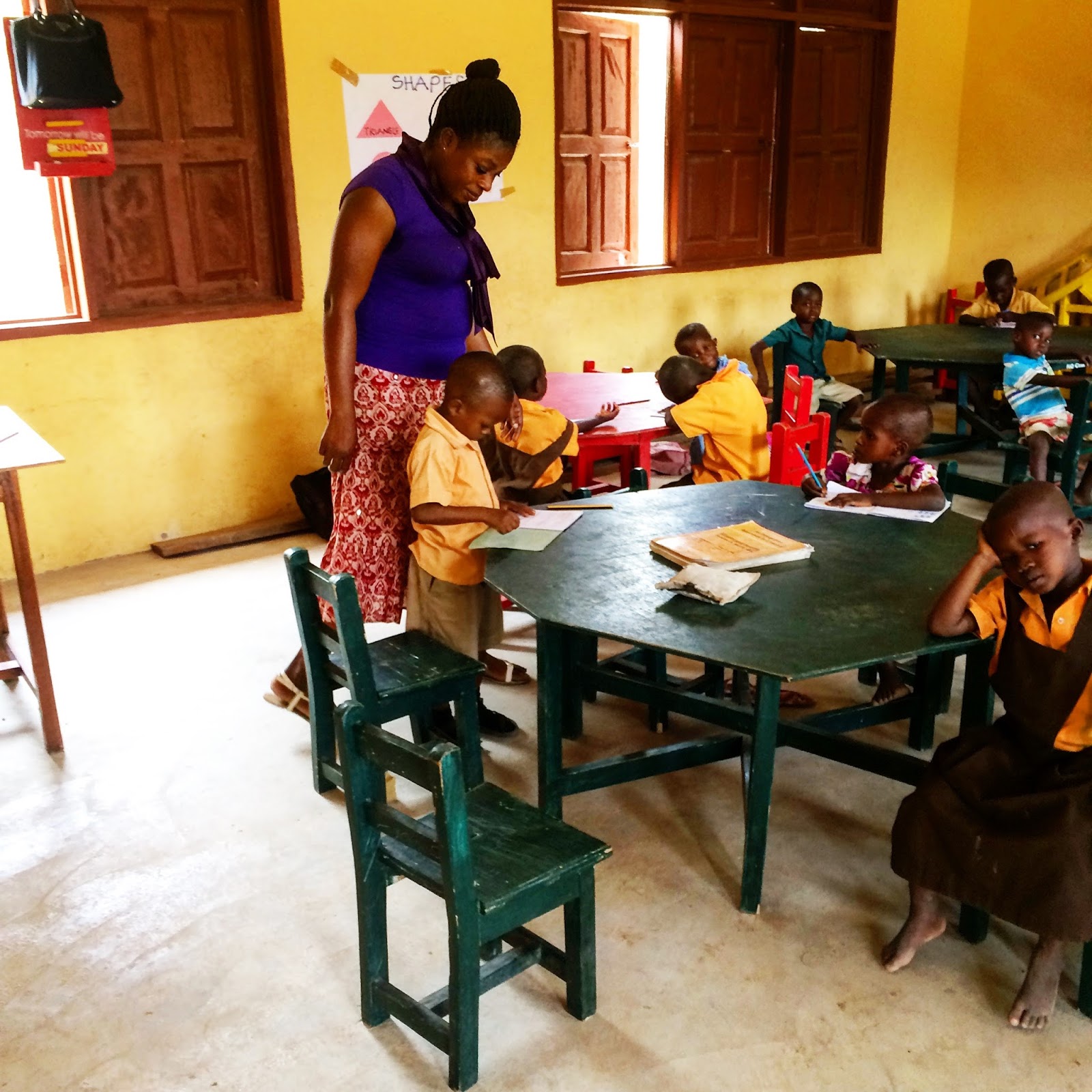
Rural School

Having a ‘servant’ made me feel uncomfortable, to say the least. I approached my colleagues and asked questions to my host family about the circumstances that would make this situation just. They told me that since she is able to attend school it is a way for her to pay her school fee’s and for that she is fortunate, that my house family were doing the Christian thing by employing her. In a country where the minimum wage is just under $2.00 Canadian dollars a day ( a day!), sometimes there is no other alternative. My colleagues tell me our maid was lucky to find work and should be thankful for it. I see it as a sign of a society still struggling cultural norms that counter their development.  

My main issue was that I was here to work in development with women. How could I work in development from one side and yet benefit from the labour of a child on the other? I realised that she is one of the lucky ones to find a home that allows her to study and work and is in comparison a happy environment for her to do so, the alternative is remaining in poverty and still needing to work as her parents could not support her. Her work further removes her from vulnerable situations that lead to child trafficking, child marriage, abuse and violence.  If I were to deny her work I would be the oppressor in this situation, so I needed to just deal with it and accept a culture different than my own.


When no one is around I hear her signing to herself, nursery rhymes, the national anthem, TV ads. I turn on the TV and let her pick the show she likes, she watches from the hallway never daring to sit on the sofa. I sneak her treats, offer her rides to school and make sure to clean up after myself not wanting to create any additional work for her. I mourn for the loss of her childhood as she is often alone and working without the freedom to play and be a kid and at the same time I celebrate her ability to educate herself and lift herself out of extreme poverty.  The issues are never as plain as it seems. I endeavour each day do show her kindness, offer smiles and speak to her as the beautiful individual that she is.

 XX Melanie


"It is vital that when we are educating children's brains that we do not neglect to educate their hearts" Dalai Lama


Wednesday, 8 February 2017

A Day in the Life of a Sexual Health Worker in Ghana


A good word to describe my day today is; heavy. I came to Ghana to work with an NGO in business development with female farmers in a rural part of the country. I had a moment today as I was sitting in a brothel in the slums of Accra when I thought, “what the hell am I doing here”. It passed quickly as I collected the strength to put on my game face to get through our work. Being confident around the sex workers and their pimps meant the difference between polite hello’s and being taken advantage of.  This is how I found myself there.
            A coordinator at the office came to me yesterday and told me I was coming into the field with her, I spent last week sitting in on a Peer Educator course for male sex workers and had learned about how they recruit current and former sex workers, train them in sexual health and send them out to teach their peers. All of this had been theory until this morning when I was told to show up at a place on the other side of town and to wear good shoes as it may be dirty, which was all the information I was given. In the morning I was contacted by one of the women I was meeting with very specific instructions on how to get to the site, she called four times as it seems they were very attentive to my wellbeing and whereabouts. When I reached the bus depot to transfer towards my destination someone shouted out “Obruni (white person) where are you going?” He laughed when I told him and asked why I would want to go there. Why indeed.
I got off the bus at the designated spot and as I looked around I knew I was close to the market, a busy part of town mostly devoid of foreigners, especially on their own. People shout at me from across the street and from cars and motorbikes going by “Obruni, where are you going? What are you doing here?” My colleague arrived in time to save me from awkwardly rejecting a man asking for my phone number so we could marry and I could bring him back home with me.  She led me through a maze of huts and converted shipping containers that made up the community they were working in, towards their satellite office. As I swatted away the flies I choked back the urge to cough at the pungent odors at every turn.  Frying fish, a dead dog, garbage everywhere, the smell will haunt me in my dreams tonight. We waited for the team to arrive, children running by me and gawking at the unfamiliar visitor, one even so bold as to poke me and run away. As most of the women I was working with had limited English the conversation hung around them giggling at the nickname they had given me the week before “Nana Afia” or Queen Friday, as this was the day I was born which is significant to them. Once everyone had arrived it was time to head out. When I asked them where we were heading and what we were doing they said “Were going to meet the women”, I was really in it now.
Our group of seven women accompanied by three male assistants walked calmly through the muddy pathways towards a more trafficked area. There someone pointed to a narrow doorway leading into a dark room, “we're going in there”. Pricilla, the one who had picked me up from the bus stop pulled me aside and told me “we are going in there, don’t worry they are mostly Nigerian and can speak English”. When I asked what I needed to do I was answered with a wave through into the darkness. As I entered I was greeted with the smell of marijuana and sweat that simmered in the air along with pulsing beats coming from a sound system on max. Women that were casually dressed sauntered about the room and peeked out of hallways, a few men passed through the room, drinking and smoking and not paying much attention other than to stare me down for being the odd looking Obruni in the room. My colleagues, familiar with some of the women seemed totally at ease, introducing me to some of their old favourites. I politely smiled, shook hands and said many hello’s, watching in awe as the women quietly and efficiently set up shop inside. A Peer Educator (PE) I came in with, a dainty, seemingly calm looking girl produced a wooden dildo from her purse and stuffed it between her legs. She then unwrapped a condom and demonstrated how to properly wear one, surprising many of her viewers who were unfamiliar. While that was going on another PE set up her work station “were going to do the testing”, right here, in this unlit room inside the brothel. I volunteered to hold her phone as a light throughout the procedures, offering what little assistance I could in this situation.
One by one the other PE’s would pull aside a sex worker and take down their information and then send them towards us for testing. Just a prick of the finger and 5 minutes was all it took to identify antibodies that would indicate HIV status. I was amazed as this women had clearly been well trained and masterfully processed each women through, giving each one a number on the wrapper from the antiseptic wipe that had sterilized their finger to correspond with the number on the test waiting to be finalized. We tested 35 women in just over an hour, at the end they called for “results, results” and they each came forward for a private whispered answer muffled by the blaring afro beats that filled the room. One tested positive. The one that had earlier asked if she could do anything for me with a wink and a riotous laugh at my quick rejection. As she was told the news her face remained unreactive, she had been complaining of sores on her arms and face and wondered if they were connected. I too remained blank to try to keep the privacy of the moment between us. We then indicated to a supervisor her positive results so they could follow up with her, I fought back tears, this was not the time nor the place for such emotions.

We left only when we had run out of test kits, needing to return because we hadn’t seen everyone. “They are all new inside, so we have many tests to do” the routineness of her statement stuck with me. I was led to the police station; it was good practice to keep the police informed of our activity in the area. As the golden ticket I was paraded through to a constable and a police chief “this is a volunteer come to see our work” “You are welcome” they would say. What was I doing here? It didn’t matter anymore. What mattered was that these women were putting themselves on the line everyday, these are the world’s superhero’s, women will save us all. I’m going out again tomorrow, even if it was just to shine a light on the work being done here.    


Wether your day was light or heavy like mine, I hope it meant something. 

XX Melanie