Tuesday, 28 February 2017

Coming to Terms With Child Labour in Ghana

I am awoken around 04:30 each morning by the sounds of the maid setting the charcoal fire outside my window. She does this so our family has hot water for making breakfast, to do the laundry and for baths, it an essential part of each day. When I arrived in the village I was introduced to the ‘girl’ who assisted with domestic work while both parents were busy running a shop in town. I thought she appeared quite young, thinking she was maybe 16, the age most kids finish school at in Ghana. I later found out she was just 12 years old.
Road Side Hawkers 

As per a recent local news story I read, up to 1.2 million children under the age of 16 are reported to be working every day in Ghana. Many of them harvesting and processing in agriculture, mainly the Cocoa that we turn into our beloved chocolates.  Critics will tell you this number is exaggerated and that kids often help their parents when they return home from school and on weekends. It only takes a periphery glance to see that this is not always the case and that little bodies occupy much of the lower income work from street hawkers, to agricultural workers to domestic service.

Grandma and maid making Fufu
Our house 'girl' works every day helping with house chores and childcare. She sweeps the dust that surely settles on the floors each morning, wipes counter tops, chases after the children, does laundry and dishes and any other tasks as required by her household. Even the children who are 18 months, 3 and 6 call for her to fetch things for them and clean up after them. When the kids are readied for school each morning she too sets off to attend classes, she is in grade 5. She returns home around 13:30 and continues with her chores until the children return home from school. She works into the evening cleaning up dishes after the mother has cooked and other tasks as assigned to her. She is given a single bed in the corner of the kid’s playroom as her space. I have never seen her eat, as she is not invited to with the family. The way she is treated by her elders is very harsh to my delicate north American understanding of child care.  
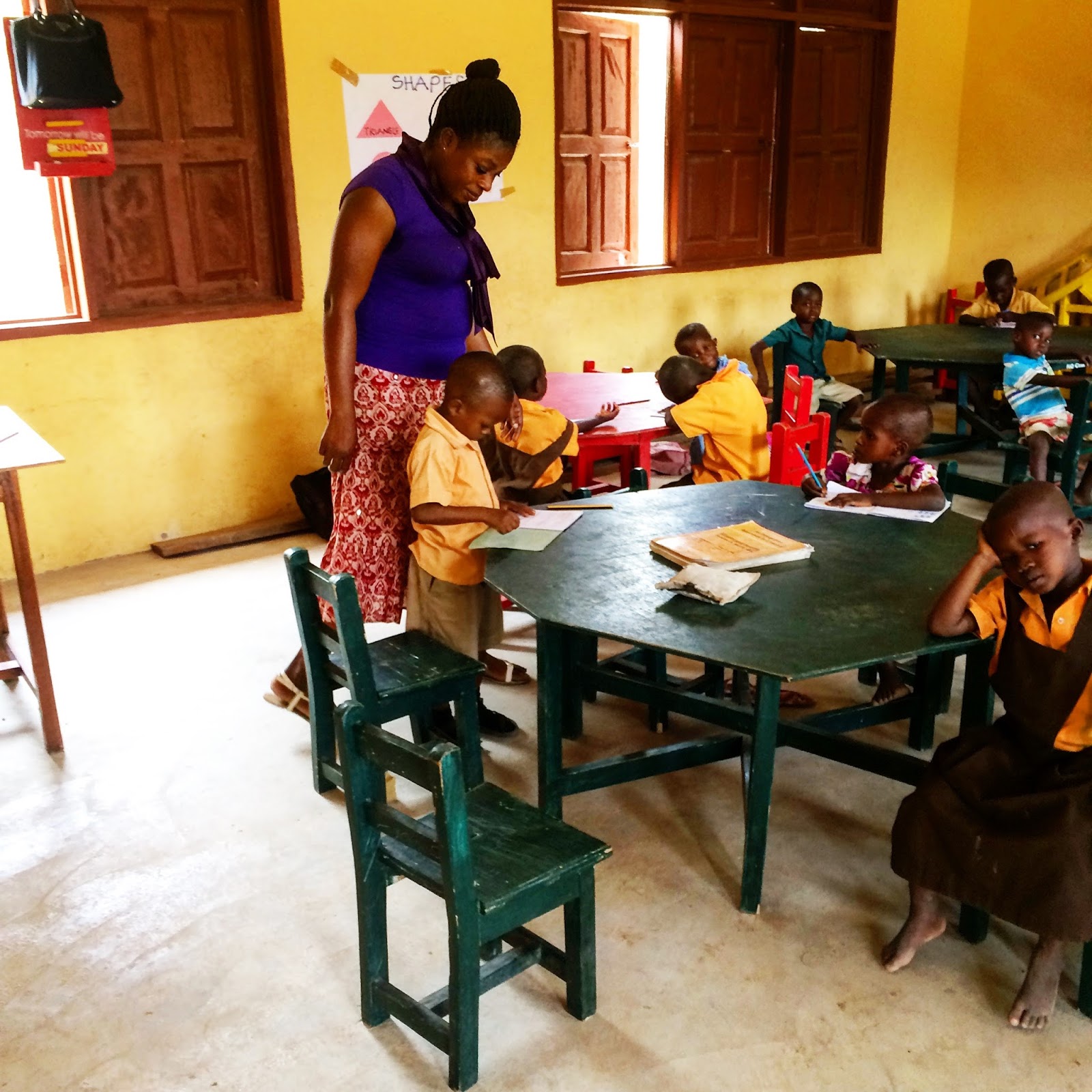
Rural School

Having a ‘servant’ made me feel uncomfortable, to say the least. I approached my colleagues and asked questions to my host family about the circumstances that would make this situation just. They told me that since she is able to attend school it is a way for her to pay her school fee’s and for that she is fortunate, that my house family were doing the Christian thing by employing her. In a country where the minimum wage is just under $2.00 Canadian dollars a day ( a day!), sometimes there is no other alternative. My colleagues tell me our maid was lucky to find work and should be thankful for it. I see it as a sign of a society still struggling cultural norms that counter their development.  

My main issue was that I was here to work in development with women. How could I work in development from one side and yet benefit from the labour of a child on the other? I realised that she is one of the lucky ones to find a home that allows her to study and work and is in comparison a happy environment for her to do so, the alternative is remaining in poverty and still needing to work as her parents could not support her. Her work further removes her from vulnerable situations that lead to child trafficking, child marriage, abuse and violence.  If I were to deny her work I would be the oppressor in this situation, so I needed to just deal with it and accept a culture different than my own.


When no one is around I hear her signing to herself, nursery rhymes, the national anthem, TV ads. I turn on the TV and let her pick the show she likes, she watches from the hallway never daring to sit on the sofa. I sneak her treats, offer her rides to school and make sure to clean up after myself not wanting to create any additional work for her. I mourn for the loss of her childhood as she is often alone and working without the freedom to play and be a kid and at the same time I celebrate her ability to educate herself and lift herself out of extreme poverty.  The issues are never as plain as it seems. I endeavour each day do show her kindness, offer smiles and speak to her as the beautiful individual that she is.

 XX Melanie


"It is vital that when we are educating children's brains that we do not neglect to educate their hearts" Dalai Lama


Monday, 20 February 2017

12 Things I Wish I Knew Before Travelling to Africa

Having been in Ghana a mere three weeks I still have a lot to learn about the local culture and customs. Yet already I become a little hardened to the traditions that effect me daily. Here is a list of things I wish I had learnt before setting out on my trip to Western Africa:

1.     You will stick out
·      I mean, I knew I would be noticed but it is hard to describe the level of attention I get at any given moment of my day. Obruni- is what they call white people, and I hear that word literally hundreds of times walking down the street, children’s mouths go agape at the site of me, women pull my hair on the bus and men are constantly making kissy noises to get my attention.  Even though I may not be the first Obruni they have seen, it is still uncommon enough to call attention to.
2.     Sexual Harassment is a cultural norm
·      Not only do the men gawk at me but they follow me down the street, tell me they love me and want to marry me on the spot and even grab at me. All these are apparently typical of the Ghanaian and even African man but only more intense to the stand alone Obruni who draws more men than usual. Being a solo traveller and a plus size women I am further targeted for my apparent wealth and birthing hips. Basically I have to get used to it, grin and bare it and stand up for myself when I think they’ve gone too far.
3.     Say hello to everybody
·      In my first week I learnt that everyone says hello, good morning, good afternoon, it is customary.  It has felt like I have been inundated with welcoming words to the point that they were overwhelming. Now I am being proactive and making sure to say hello first, people are generally more pleasant when I make this small effort and return with “you are welcome”.
4.     People are blunt
·      Ghanian's especially are somewhat blunt with realities we in the western world tend not to talk about openly. If you have a pimple on your face they will point it out, if your hair is messy they will pull on it and tell you, if you are overweight they will straight up tell you ‘you are fat’. Sometimes a waiter will notice I have finished my meal and say you are fat do you want more food, other times it is a child saying “you are fat, I like your face”. In any case it is a plain observation I have been hiding from my entire life and even though it is ingrained as shameful to westerners it is seen as a sign of wealth and excess here. Again, I grin and bare it.
5.     The food is spicy!
·      As a self-proclaimed wimp I am fully trained in asking for no spice when ordering food. Though everyone’s definition of spice is so varying I mostly look at what’s on the kids menu as a cheat to see what will have less ‘flavour’. This doesn’t work here, even kids can handle dishes that to me taste like pure hell fire released on my tongue. With tears streaming down my face I always try to push through, much to my digestive systems dissatisfaction
6.     Dress Up
·      Here’s me with my hiking boots and t-shirt, around me everyone is stylish AF! In Ghana, they take a lot of pride in their appearance and despite the heat everyone dresses sharp, especially for work. I immediately regret nearly everything I brought, and all my favourite dresses I left behind. It can also be seen as a sign of disrespect to dress down as it is perceived I do not deem the people worthy of the effort, hopefully the new dresses I’m having made will help my image.
7.     Learn the local languages
·      Even though they told me everyone speaks English, they really don’t use it for day-to-day chatter and in some of the rural villages I will be working in. I wish I had spent time before I came getting in a few more basics but instead I will have to learn as quickly as I can here.
8.     It’s hot!
·      Ok now you’re going, Mel, what were you expecting it’s Africa! But the heat is just constant and inescapable. I would have taken more consideration in the things I brought because things melt! My fabrics are too heavy; my hair needs to be up all the time and I need industrial strength deodorant!
9.     The Internet sucks
·      Though the average adult African has 3 cell phones the networks coverage is as sparse as the food is spicy (so lots!) Even uploading this blog can take an entire day, patience is a virtue to learn whilst you are here.
10. You will always be the outsider
·      Sometimes I feel like the people I work with would have preferred a monetary contribution over having me, other times I am overwhelmed with their gratitude, either way I am always cognisant that I will never be fully accepted by the locals who sometimes hold a bit of resentment for my presence.
11. Friends back home will forget you
·      Not on purpose, but soon enough everyone will move on with their lives and forget that you are isolated on the other side of the world with hardly anyone to talk to. Those few calls or messages I get count a million times more when the long days of solitude are broken up with friendly voices.  
12. You will question your intentions
·      I am constantly checking my motivations for being here, questioning its validity, quietly chastising myself for coming.  Will any of this matter? Have I just fallen into the very same stereotypes I’ve been trying to avoid? Am I just another white girl on a voluntourism trip to Africa? When everything else weighs down on me I think about how hard I need to work to prove it all wrong and how much of an impact I can hopefully have with the people I work with.  

All the best until next time,

Melanie XX

Wednesday, 8 February 2017

A Day in the Life of a Sexual Health Worker in Ghana


A good word to describe my day today is; heavy. I came to Ghana to work with an NGO in business development with female farmers in a rural part of the country. I had a moment today as I was sitting in a brothel in the slums of Accra when I thought, “what the hell am I doing here”. It passed quickly as I collected the strength to put on my game face to get through our work. Being confident around the sex workers and their pimps meant the difference between polite hello’s and being taken advantage of.  This is how I found myself there.
            A coordinator at the office came to me yesterday and told me I was coming into the field with her, I spent last week sitting in on a Peer Educator course for male sex workers and had learned about how they recruit current and former sex workers, train them in sexual health and send them out to teach their peers. All of this had been theory until this morning when I was told to show up at a place on the other side of town and to wear good shoes as it may be dirty, which was all the information I was given. In the morning I was contacted by one of the women I was meeting with very specific instructions on how to get to the site, she called four times as it seems they were very attentive to my wellbeing and whereabouts. When I reached the bus depot to transfer towards my destination someone shouted out “Obruni (white person) where are you going?” He laughed when I told him and asked why I would want to go there. Why indeed.
I got off the bus at the designated spot and as I looked around I knew I was close to the market, a busy part of town mostly devoid of foreigners, especially on their own. People shout at me from across the street and from cars and motorbikes going by “Obruni, where are you going? What are you doing here?” My colleague arrived in time to save me from awkwardly rejecting a man asking for my phone number so we could marry and I could bring him back home with me.  She led me through a maze of huts and converted shipping containers that made up the community they were working in, towards their satellite office. As I swatted away the flies I choked back the urge to cough at the pungent odors at every turn.  Frying fish, a dead dog, garbage everywhere, the smell will haunt me in my dreams tonight. We waited for the team to arrive, children running by me and gawking at the unfamiliar visitor, one even so bold as to poke me and run away. As most of the women I was working with had limited English the conversation hung around them giggling at the nickname they had given me the week before “Nana Afia” or Queen Friday, as this was the day I was born which is significant to them. Once everyone had arrived it was time to head out. When I asked them where we were heading and what we were doing they said “Were going to meet the women”, I was really in it now.
Our group of seven women accompanied by three male assistants walked calmly through the muddy pathways towards a more trafficked area. There someone pointed to a narrow doorway leading into a dark room, “we're going in there”. Pricilla, the one who had picked me up from the bus stop pulled me aside and told me “we are going in there, don’t worry they are mostly Nigerian and can speak English”. When I asked what I needed to do I was answered with a wave through into the darkness. As I entered I was greeted with the smell of marijuana and sweat that simmered in the air along with pulsing beats coming from a sound system on max. Women that were casually dressed sauntered about the room and peeked out of hallways, a few men passed through the room, drinking and smoking and not paying much attention other than to stare me down for being the odd looking Obruni in the room. My colleagues, familiar with some of the women seemed totally at ease, introducing me to some of their old favourites. I politely smiled, shook hands and said many hello’s, watching in awe as the women quietly and efficiently set up shop inside. A Peer Educator (PE) I came in with, a dainty, seemingly calm looking girl produced a wooden dildo from her purse and stuffed it between her legs. She then unwrapped a condom and demonstrated how to properly wear one, surprising many of her viewers who were unfamiliar. While that was going on another PE set up her work station “were going to do the testing”, right here, in this unlit room inside the brothel. I volunteered to hold her phone as a light throughout the procedures, offering what little assistance I could in this situation.
One by one the other PE’s would pull aside a sex worker and take down their information and then send them towards us for testing. Just a prick of the finger and 5 minutes was all it took to identify antibodies that would indicate HIV status. I was amazed as this women had clearly been well trained and masterfully processed each women through, giving each one a number on the wrapper from the antiseptic wipe that had sterilized their finger to correspond with the number on the test waiting to be finalized. We tested 35 women in just over an hour, at the end they called for “results, results” and they each came forward for a private whispered answer muffled by the blaring afro beats that filled the room. One tested positive. The one that had earlier asked if she could do anything for me with a wink and a riotous laugh at my quick rejection. As she was told the news her face remained unreactive, she had been complaining of sores on her arms and face and wondered if they were connected. I too remained blank to try to keep the privacy of the moment between us. We then indicated to a supervisor her positive results so they could follow up with her, I fought back tears, this was not the time nor the place for such emotions.

We left only when we had run out of test kits, needing to return because we hadn’t seen everyone. “They are all new inside, so we have many tests to do” the routineness of her statement stuck with me. I was led to the police station; it was good practice to keep the police informed of our activity in the area. As the golden ticket I was paraded through to a constable and a police chief “this is a volunteer come to see our work” “You are welcome” they would say. What was I doing here? It didn’t matter anymore. What mattered was that these women were putting themselves on the line everyday, these are the world’s superhero’s, women will save us all. I’m going out again tomorrow, even if it was just to shine a light on the work being done here.    


Wether your day was light or heavy like mine, I hope it meant something. 

XX Melanie

Friday, 27 January 2017

Ghana Girl


Bussels Airport
From 12,000 meters in the sky I write en-route from Brussels to Accra, Ghana. Last night we passed over Greenland and I saw the northern lights for the first time ever. I think staring at the shimmering green lights I had a moment of realization, it had finally sunk in that I was moving to Africa for a year. It wasn’t when I had the 7 vaccines, or the 6-week wait on my visa or even trying to fit my life into one backpack. This was really the point of no return, and my whole world was about to change.

After my last contract I decided that I wanted to do something a little different, I wanted a challenge, something to shake me up and something outside of my comfort zone.  I am young, single, and able bodied and now with a degree I literally have all the privileges and opportunities in the world. I wanted to offer what I am and what I have to the rest of the world and I wanted to do it as a volunteer while I could still afford to.  Using my experience in agriculture and business I will be working with women farmers in a rural area to improve their processing and distribution while increasing their individual and community food security.

For some reason I always had a quiet dream to live and work in Africa one day. I usually shrugged it aside as a childish pipe dream, never really thinking it would happen but secretly always wishing for it. I don’t know what it was that attracted me to Africa other than the total unknown. It never really occurred to me that my degree in environmental studies would take me where I had always wanted to go.

Women's March-Ottawa
To tie everything in together was the motivation I gained from the recent women’s marches on Washington and around the world. This highlighted for me the need for us women to work with and for each other. It is only through improving women’s lives around the world that we will gain equality. After the march I attended in Ottawa there were presentations and speeches, one in particular by the managing director of Crossroads International (coincidentally or not the organization sending me to Ghana) stood out to me. She spoke about the work they were doing across the developing world to further women’s rights and empowering women and how many places still had a lot of work to do to rise to the level of our western ideals. Tears streaming down my face it was as if I was in the right place at the right time to hear her message, and I was going to do the work that was needed, the work that was driving the women’s rights movement.
In Flight Ice Cream!

Lunch is being served now, the plastic cutlery and disposability of air travel reminds me how many emissions I am producing by my journey, but the lifestyle I will be leading will be very different from the wasteful North Americans I think. Time to travel to a place where the 100-mile diet is less of a new age fad and more of a way of life. Where you shop at farmers markets for everything not just luxuries and where a slower pace of life will quiet my mind and allow me to take it all in.

Much love,

Melanie 


"To travel is to live"- Hans Christian Anderson

If you would like to support my work or learn more see my funding page here: https://cci.akaraisin.com/pledge/Participant/Home.aspx?seid=2478&mid=9&pid=3045663

Friday, 28 October 2016

Minimalism Mel?

Capilano Suspension Bridge- Vancouver, BC
My contract was up, my lease was up, I looked around and realised I was totally free! How lucky I felt. So I decided to pack up and move on. I am currently road tripping through the US on route to Ottawa to see some folks. From there I am going abroad, to where is still undecided. What was decided was that I needed less stuff. Thus the struggle, challenge and liberating experience began to eliminate all the things from my life and to fit into my little coupe.  As therapeutic as it may seem to sell off my worldly possessions to travel again, it is also a very difficult and humbling experience for me. Though this is not the first time I have moved away, or started over, this time I am approaching it from a different angle.

The first time I left home I was 21 and heading to Europe. I sold all the IKEA furniture I had accumulated in my Toronto apartment, stored many boxes at my parents and took 4 suitcases with me. I got rid of the cheap things that I collected to fit into the world I didn't. I moved to BC with 3 suitcases, but would have needed a moving van to leave it. This time around I took care and time in accumulating the things I now wish to rid myself of, which is maybe why its hurting more. They may be worth less in gold but I carefully thrifted, swapped, received and made everything I have now. When I sell my car it is something that I took time in searching for, painstakingly maintained and made memories. It makes it harder to part with.

Mt Walker- Olympic National Forest, WA
Last week was hard, I sold my chickens who were a source of food from their eggs and beloved pets. Then I sold my bicycle, Bernadette, a bike I loved so much I named. With the weight of their worth in my pocket in the form of funny coloured bills I replaced my things with a value that doesn't translate to how I valued them. To me its not as simple as buying something new. Its a choice every time I make a purchase, towards the type of economy and world I support and want to live in.

Donating old clothes, selling off furniture and pieces I could have kept a lifetime. That's just it, I don't need any of it. I remind myself every time. When I teared up a bit when my last chicken left I told myself "I will survive." The ability to willingly let go of these things, even if I love them is in itself a privilege. I acknowledge this and vow to use their "worth" towards the idea that I will find happiness through the experiences I am about to have, and not through the things I am letting go of.

By shedding what ties me down to this place it also makes me free from it.

Bob Red Mill- Milwaukee, Or
Minimalism Mel? When it all adds up; having things translates to consuming. We should all consume less to preserve the environment and its resources, therefore minimalism should be embraced. This time I plan to go abroad with 1 bag, and leave behind 1 box. Every time I buy something I need to ensure I have to space and willingness to carry it with me, it makes me buy less. Every day on my road trip I eliminate something from the car, its like a little game I play. Yesterday the cooler got cut "you have been eliminated" I told it, as I dropped it off at goodwill in downtown Portland, Oregon.

Things can be replaced,  you can learn to live with less, the adventures and memories I'm making cannot.

Have a lovely day,

Melanie

Follow me on my travels on Instagram @melaniejadea

"The ability to simplify means to eliminate the unnecessary so that the necessary may speak." -Hans Hoffman


Wednesday, 19 October 2016

10 Reasons I am getting my tubes tied, Today!


At 26, I am sure I do not want children. I am so sure that today, I am getting my tubes tied! In a simple, 45 minute procedure I will do away with a future of worrying about reproductive health and my clock ticking. It is so routine that  I will be back in my bed this evening with the assistance of a friend and back on my feet tomorrow afternoon. Easy peasy.  Let's all get one!

I have been considering having my tubes tied as a more permanent form of contraception for many years. However, if you are under the age of thirty and have not had children, it is highly unlikely a doctor will agree to such a procedure. It is just too common for us women to change our minds apparently. As my doctor explained to me, up to 30% of women who have their tubes tied will have it reversed and only 30% of those women will be able to conceive afterwards. He told me he didn't want to live with the guilt of taking away a woman's ability to give birth, especially a young, unmarried and childless woman.

I had an IUD put in at 21 the first time I asked a doctor about more permanent contraceptive methods. She said I was too young to make those kinds of decisions. I agreed that I could think on it more. Five years later I was at the end of a 13 month waiting list and sitting in a room filled with expecting mothers and young children plotting out my arguments. In an effort to convince this strange man of my assuredness, I built my case with these points:
  1. Human Overpopulation- Number one reason for me not to have children is because the world just has to many bodies on it right now. We have surpassed the carrying capacity of our planet by not being responsible breeders. Too many people use up too many resources and take up too much space from other species. The easiest solution is, have less children immediately. Fortunately, the birth rate has been declining as the developing world is beginning to have smaller families but the rise in population is forecast to increase for the next 35 years or so. Right now what you can do it decide not to have any more mouths to feed.
  2. I have never seen myself as a mother. I know the urge to be a mother usually develops over time. It is just something I do not see for me. 
  3. My body, my choice.
  4. No more pill! I started on the pill at 12!!! I will not longer need to rely on hormones and pharmaceutical companies foe my reproductive health and responsibilities. 
  5. Insurance- Literally the main reason I (and many young women) ever worry about insurance was to pay for the pill. 
  6. Chemical Free, I can live a life less chemically altered than taking hormonal contraceptives for the majority of it. 
  7. Environment, so not only will I be using less chemicals, I will also be reducing the amount of run-off or sewage of contraceptives that get into our water stream and have effected hormone levels in men and children- See article 
  8. Adoption- There are so many children in the world who need a home that it just seems selfish of me to have my own children. My doctor asked me what would happen if I met someone who
    wanted children and I explained that my ideal person would also be thrilled with adoption if we decided to take on children together. Until then I am free to wander, me by my unattached self.
  9. I have more interest in my chicken babies than real ones. 
  10. No more explaining. I will be able to shut down anyone who asks me if or when I'm having kids, again. "I just can't". I really am just saving myself from a lifetime of reproductive questioning and bullying by the mainstream who attempt to devalue me as a woman for my choices. 

I love babies, they are beautiful and necessary to perpetuate our existence. We just have so many, too many and my little drop in the bucket is to not contributing to that. I worry my friends and family with children will judge me as rejecting them and their lifestyles. Please do not. I think your little dears are just precious. My choice does not mean I do not respect yours, but it it my choice. The message for me is, you have one!


Have a lovely day,

Melanie


Wednesday, 12 October 2016

Murder and Meat Mondays

Over the past couple of years I have been on a journey of self discovery and learning about a how to make the food system more sustainable and just for everyone. One of the pieces that I have struggled with is to eat meat or not to. I have been a vegetarian for the better part of 14 years (as described in this post), and have always toted "if I can kill it, I can eat it" as my reasoning behind abstaining. Living in my little corner of heaven on Vancouver Island I am on an organic farm, next door to an organic farm, free range- grass-fed beef farm and an artisan cheese making dairy with SPCA certification. What a place to be for a local food lover.

The Neighbours have been raising 150 unsexed chicks which meant a bunch of unintentional roosters were produced. Working there I saw them butcher a couple a week to eat, they had to be disposed of because too many roosters is a very violent place for chickens. I understood that this was humane, the meat was organic, the animals free run and happily clucked about their days. So why shouldn't I eat this meat?


Because I was given the opportunity and was able to watch a few being processed I worked my way up to be the actual executioner. The knife was placed in my hands and I sawed off its head after a few minutes of squirming. It wasn't pretty, but I got through it. I helped pluck the feathers and the farm roasted and spiced it up. Later I was presented with a piece of chicken,  it could have been any old piece of meat but this time I was responsible for its life. It tasted, a little tough to be honest. I had never tried rooster before but kept seeing the head while I chewed him up. As a recovering vegetarian it was a very odd experience for me and I didn't 100% enjoy it. In the next few days I would work on the leg piece I was given but my body rejected those foreign enzymes I wasn't used to and I was a little sick. 

I tried again soon after, I went for back-bacon from the neighbours freshly butchered hogs, the ones I had personally delivered from the butchers. This time it tasted rather delicious but again my body unaccustomed to any meat was being over loaded and let's just say, that week was a bit icky. Having access to good, local food has definitely been a game changer for my diet and stomach.

Now, I am not about to hit a drive-through and order an unidentifiable cheeseburger any time soon, far from it. But instead, I am incorporating meat into my diet that is local and sustainable from trusted and known sources. I was recently given a meat bonus from work (I know right) that is ground beef from one of the older dairy cows. Other than being the coolest job ever it also means I am using an animal who's meat is not highly valued in the market and using it to its full extent.

I would rather support the industry of small, organic farmers, treating animals fairly and butchering good, sustainable meat sources than revolt an entire system that is other wise a natural part of the human diet. Being a vegetarian ignored so many parts of life that involve animals. Most shoes have leather pieces, cheese has rennet from cows, agriculture is responsible for eco-system destruction and deforestation. At the end of the day all the food we eat negatively impacts the lives of animals and the world around us and none of us from vegan to carnivore are innocent of this. So a balance must be struck. I have a problem with the industrial food system and not small farmers and it is important to remember that.

In the end, support what kind of food you hope everyone can eat one day. For me that is farm fresh and local that includes organic produce, meats & grains. And everything in moderation, Meat Mondays!

In good food,

Melanie